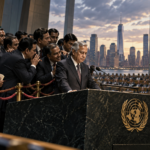
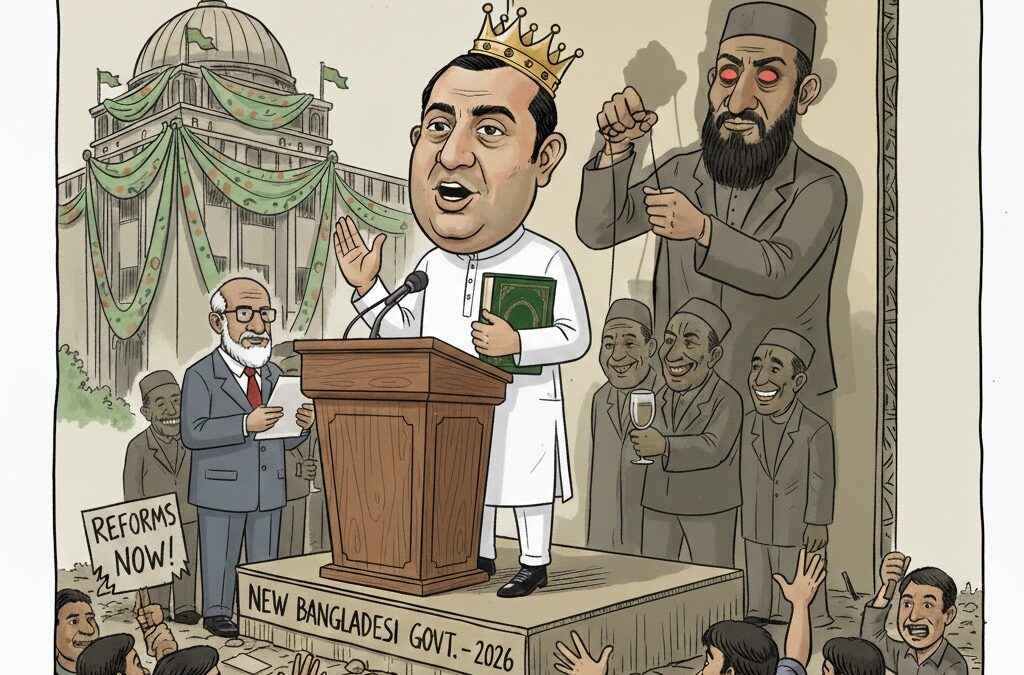
DHAKA—If you look closely at the bunting draped over the South Plaza of the Jatiya Sangsad Bhaban today, you’ll notice it’s surprisingly similar to the decorations used twenty years ago. As Tarique Rahman took the oath of office as Prime Minister this afternoon, the air in Dhaka wasn’t filled with the electric charge of revolution, but rather the heavy, cloying scent of a political cycle that refused to break.
After eighteen months of an interim “cleansing” period under Nobel laureate Muhammad Yunus, the “Monsoon Revolution” of 2024 has delivered us exactly where we started: the hands of a dynastic scion. Today’s ceremony wasn’t a step forward; it was a retreat into the comfortable, toxic embrace of the past.
The Dynasty Strikes Back
Let’s call it what it is. The 2026 election, billed as a “Gen Z-inspired” reset, has resulted in the restoration of the House of Zia. Tarique Rahman, the son of a former president and a former prime minister, has spent nearly two decades in London, essentially waiting for the wheel of fortune to crush his rival, Sheikh Hasina.
Now that the wheel has turned, we are told this is a “New Bangladesh.” But look at the Cabinet list:
-
The Loyalists: Familiar faces from the 2001–2006 era have been dusted off and given ministerial portfolios.
-
The Power Brokers: The same oligarchs who shifted their allegiances from the Awami League to the BNP the moment the wind changed are already seen flanking the new PM.
-
The Rhetoric: Rahman speaks of “reconciliation” and “stability,” the same script used by every incoming leader to mask the inevitable purging of the previous regime’s bureaucrats.
The faces in the front row today weren’t the student leaders who braved bullets in 2024; they were the party stalwarts who spent the last decade in the shadows, sharpening their knives for this very afternoon.
The Jamaat Shadow: The “B-Team” Reality
Perhaps the most chilling aspect of today’s ceremony wasn’t who was on stage, but who was smiling from the front row. While the BNP secured a majority, the resurgent Jamaat-e-Islami—contesting its first election since 2013—has secured a staggering 77 seats.
Make no mistake: this isn’t just a coalition of convenience; it looks like a hostile takeover of the national identity. For months, we’ve watched the BNP play “B-team” to Jamaat’s ideological hardliners. The “July Charter” was supposed to be about democratic reform, yet it’s being steered by an 11-party alliance dominated by Islamist interests.
The concern isn’t just political; it’s fundamental. We are seeing a government that seems more interested in settling scores and enforcing a narrow, regressive social vision than in the inclusive, secular democracy the students died for. When the BNP’s “clean politics” looks identical to Jamaat’s “disciplined cadre” tactics, you know the revolution has been hijacked.
The Referendum Farce
While the BNP celebrates a landslide, the simultaneous constitutional referendum on the “July Charter” feels like a hollow victory. The BNP has already signaled a reluctance to fully embrace the “Constitutional Reform Council.”
“We haven’t been elected to a council; we’ve been elected to rule.”
This sentiment, whispered in the corridors of power, is the first crack in the facade. The reformist dreams of the interim government—term limits, judicial independence, and power-sharing—are already being treated as optional suggestions rather than mandates. The moment the “old wine” entered the bottle, it began to look remarkably like the same centralized, all-powerful prime ministerial office that had led to the last uprising.
Why It’s the Same Game
The tragedy of Bangladeshi politics is its inability to produce a “Third Way.” With the Awami League banned and dismantled, the election wasn’t a choice; it was an inheritance.
-
Corruption as Currency: Despite promises of “clean politics,” the machinery of the BNP remains rooted in the same patronage networks. The “Hawa Bhaban” ghosts haven’t been exorcised; they’ve just been rebranded.
-
The Revenge Cycle: We are already hearing reports of “administrative reshuffles”—a polite term for firing anyone suspected of AL sympathies. It’s the same pendulum, just swinging in the opposite direction.
-
Economic Deja Vu: As the new government faces 8.5% inflation and a struggling garment sector, their first instinct is to lean on the same old donor-dependent models that prioritize short-term stability over structural equity.
The Verdict: A Revolution Deferred
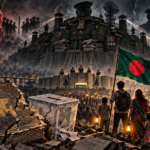
The youth of 2024 didn’t fight to replace one dynastic flag with another, nor did they fight to become a testing ground for Islamist populism. They fought for a system where the “leader” isn’t a crown prince returning from exile but a public servant accountable to the street.
Today, Dhaka is partying. The streets are full of green and red. But tomorrow, when the hangovers fade and the first regressive policies start rolling out of the new Cabinet, the people will realize that the bottle may have a new label, but the wine inside still tastes of 1991, 2001, and every failed promise in between.
The “Old Guard” hasn’t been defeated; it has just been redecorated, and it brought its most dangerous friends along for the ride.