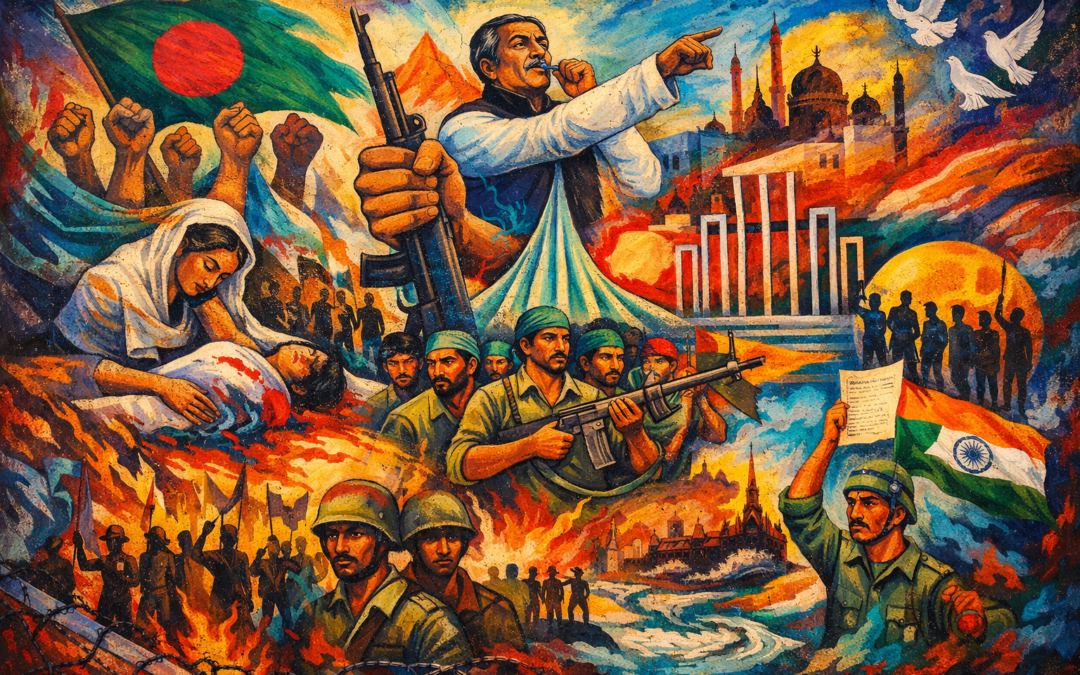
Bangladesh is not a country born out of convenience.
It is a nation carved out of fire.
It was born from genocide.
It was baptised in blood.
It was legitimised through sacrifice.
The year 1971 is not a chapter in a textbook—it is the moral foundation of the republic.
And any political movement that seeks to dilute, distort, or opportunistically weaponise that history must be examined with clarity and courage.
The So-Called “July Revolution”
In recent years, Bangladesh witnessed what was br
anded in some quarters as a “July Revolution.” The term itself was carefully chosen—designed to evoke echoes of great historical uprisings, to wrap contemporary agitation in the romance of revolutionary legitimacy.
But revolutions are not slogans.
Revolutions are judged by what they defend, not by what they destroy.
What we saw across several universities and institutions was not merely student activism. Student movements are part of Bangladesh’s proud democratic tradition—from the Language Movement of 1952 to the anti-dictatorship protests of the 1990s.
But this moment felt different.
There were reports of ideological infiltration.
There were allegations of organised networks working behind the façade of spontaneous youth protest.
There were disturbing signs of historical revisionism creeping into campus rhetoric.
And there was one underlying theme that many found alarming: a deliberate attempt to relativise, reinterpret, or quietly sideline the foundational narrative of 1971.
That is not reform.
That is erasure.
Universities: Spaces of Learning or Laboratories of Ideology?
Universities are meant to be crucibles of ideas—not factories of indoctrination.
When student politics becomes a vehicle for external ideological agendas—whether religious, ultra-nationalist, or foreign-influenced—it ceases to be organic.
Bangladesh has always had vibrant student activism. But when campus movements begin to:
-
Question the legitimacy of the Liberation War’s moral framing
-
Downplay the documented atrocities of 1971
-
Attack secular constitutional principles
-
Frame 1971 as merely a “geopolitical accident” rather than a liberation struggle
then we must pause.
The Liberation War was not an optional ideological preference.
It was a survival struggle.
The Pakistan Army’s campaign of 1971 was not abstract politics—it was systematic extermination. The mass killings, the targeting of intellectuals, the weaponisation of rape, and the attempt to crush Bengali identity are documented not only by local historians but by global journalists and diplomatic cables.
To treat that memory casually is to treat the dead casually.
The Fragility of Memory
Every nation faces a generational test.
The generation that lived through 1971 is ageing. The generation that inherits the country did not witness the carnage. Memory, therefore, becomes vulnerable.
And when memory weakens, narratives compete.
If 1971 becomes negotiable, then the republic itself becomes negotiable.
Bangladesh was founded on four constitutional pillars: nationalism, socialism (in its historical context), democracy, and secularism.
Secularism in Bangladesh never meant hostility to religion. It meant protection from the weaponisation of religion in statecraft. It meant ensuring that no citizen’s rights depended on faith identity.
To dilute that principle is to reopen the very wounds that led to the rupture of 1971.
Political Opportunism and Youth
Youth movements are powerful precisely because they carry moral energy. But moral energy without historical grounding can be redirected.
In every society, political actors attempt to harness student unrest for broader ambitions. That is not unique to Bangladesh.
The question is: were the “July” events purely about reform—or were they entangled in larger ideological battles?
If there were elements seeking constitutional engineering without broad democratic consensus, that is not revolution—that is destabilisation.
If there were calls to shield agitators from legal scrutiny under the banner of “amendment” or “impunity,” that undermines rule of law.
A republic cannot function if accountability becomes selective.
The New Government’s Response
The newly elected BNP-led government has signalled that there will be no blanket immunity for alleged excesses committed during the unrest.
That position, in principle, aligns with a simple democratic norm: no one is above the law.
If crimes were committed—whether vandalism, intimidation, coercion, or violence—due process must apply. Equally, if state actors overstepped, accountability must be universal.
Justice must not be partisan.
The danger lies in two extremes:
-
Politicised impunity
-
Politicised persecution
Bangladesh must avoid both.
1971: The Non-Negotiable Core
Let us be absolutely clear.
Bangladesh did not emerge because of abstract constitutional debates. It emerged because the Bengali people rejected cultural erasure, political subjugation, and economic exploitation.
It emerged because soldiers of the Pakistan Army attempted to annihilate a people’s identity.
It emerged because:
-
Freedom fighters took up arms
-
Guerrillas risked everything
-
Political leaders mobilised the masses
-
The Armed Forces of Bangladesh were forged in resistance
-
Millions of ordinary villagers fed, sheltered, and protected the Mukti Bahini
And yes—India’s role was decisive.
The support, shelter, training, and eventual military intervention of India and its armed forces altered the strategic balance in December 1971. Millions of refugees were hosted. Lives were saved.
History is not weakened by acknowledging this.
History is strengthened by honesty.
Secularism Is Not an Enemy of Faith
One of the most persistent distortions in contemporary politics is the framing of secularism as hostility to religion.
Bangladesh is overwhelmingly Muslim. Its culture is deeply intertwined with Islamic heritage. But it is also shaped by linguistic nationalism, Sufi syncretism, Hindu, Buddhist, and Christian minorities, and a long tradition of plural coexistence.
Secularism, in the Bangladeshi constitutional sense, is about ensuring that the state does not become an instrument of religious exclusivity.
The Liberation War was fought under the banner of Bengali identity—not religious majoritarianism.
That distinction matters.
The Real Battle: Narrative Control
The struggle today is less about territory and more about narrative.
Who controls the story of 1971?
Who defines patriotism?
Who interprets constitutional identity?
If 1971 becomes reduced to a footnote—if its sacrifices are treated as inconvenient relics—then the moral centre of the republic shifts.
Bangladesh does not need perpetual revolutionary theatrics. It needs institutional maturity.
Rule of Law Over Street Power
No democratic system can allow street mobilisation to permanently override constitutional process.
Student activism is legitimate.
Peaceful protest is legitimate.
Debate over constitutional reform is legitimate.
But coercion, intimidation, historical denial, and extra-legal manoeuvring are not.
If the recent political signals indicate a return to procedural accountability, then that is not the burial of democracy—it is its reinforcement.
Long Live the Republic
Bangladesh’s strength has never been in uniformity of opinion. It has been in resilience.
It survived 1971.
It survived coups and counter-coups.
It survived famine and political turmoil.
It survived polarisation.
It will survive ideological storms too—if it anchors itself in memory and law.
Long live Bangladesh.
Long live the constitutional spirit of secularism.
Long live the memory of 1971.
Let the nation continue to honour:
-
The Armed Forces born in liberation
-
The freedom fighters and guerrillas
-
The political architects of independence
-
The ordinary citizens who endured unspeakable suffering
-
And the millions across the border in India who offered refuge, support, and sacrifice during our darkest hour
Gratitude does not weaken sovereignty. It dignifies it.
The Way Forward
Bangladesh must:
-
Protect academic freedom while preventing ideological capture of campuses
-
Teach Liberation War history rigorously and responsibly
-
Ensure rule of law without vendetta
-
Defend minority rights as a constitutional duty
-
Strengthen democratic institutions beyond personality cults
Revolutions that attack memory eventually collapse under their own contradictions.
Nations that defend their founding principles endure.
The blood of 1971 was not shed for amnesia.
It was shed for a republic—sovereign, plural, accountable, and proud.
And that republic must never be surrendered to distortion, opportunism, or historical erasure.
Bangladesh deserves better.
And it is strong enough to demand it.