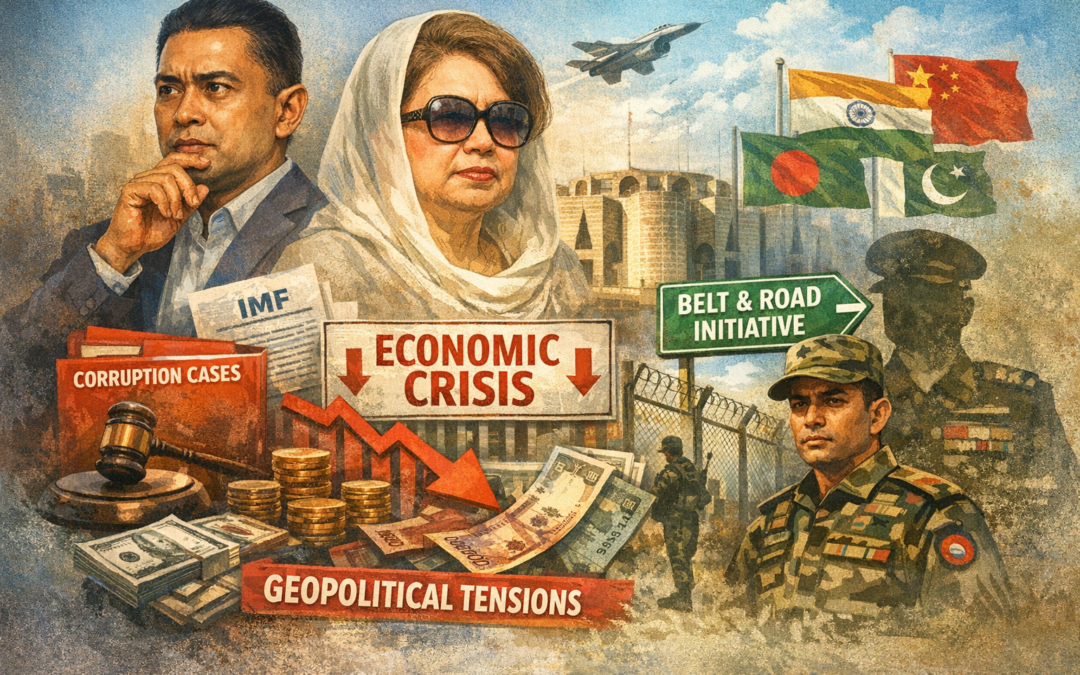
Abstract
This paper evaluates institutional, economic, and diplomatic risk factors associated with the potential return to executive authority of the Bangladesh Nationalist Party (BNP). It examines legal history, governance preparedness, civil-military relations, economic indicators, and foreign policy positioning within the broader geopolitical environment of South Asia. Rather than engaging in partisan evaluation, the paper applies political risk analysis frameworks to assess administrative capacity, reputational risk, and institutional resilience in Bangladesh’s evolving democratic landscape.
1. Introduction
Bangladesh’s political development since 1971 has oscillated between competitive electoral politics, military intervention, caretaker experiments, and dominant-party governance. As the country approaches another electoral cycle, scrutiny of leadership capacity and institutional stability becomes central.
The Bangladesh Nationalist Party (BNP), founded in 1978 by President Ziaur Rahman, remains one of the country’s two principal political forces. Its potential return to executive authority under Tarique Rahman invites examination of governance experience, legal history, diplomatic positioning, and macroeconomic management capacity.
This paper applies comparative political analysis to evaluate the structural implications of such a transition.
2. Historical Institutional Context
BNP’s ideological foundation rested on:
-
“Bangladeshi nationalism” (distinct from linguistic Bengali nationalism)
-
Greater space for Islamic identity in state discourse
-
Strong executive authority
Scholarly analyses (Riaz, 2016; Ahmed, 2019) note that Bangladesh’s civil-military balance has historically remained fragile, with interventions in:
-
1975 (post-Mujib coups)
-
1982 (Ershad takeover)
-
2007–2008 (military-backed caretaker government)
Any incoming administration must operate within this legacy of politicised institutions.
3. Legal History and Reputational Risk
3.1 Court Verdicts
Khaleda Zia was convicted in 2018 in corruption cases related to the Zia Orphanage Trust and Zia Charitable Trust. She later received conditional release on humanitarian grounds (Bangladesh Supreme Court documentation, 2018–2020).
Tarique Rahman has faced multiple legal cases, including convictions in lower courts related to the 21 August grenade attack case. Appeals and legal challenges remain politically contested.
Transparency International Bangladesh (TIB) has consistently ranked Bangladesh as facing high corruption risk across political administrations.
Table 1: Corruption Perception Index (CPI) – Bangladesh
| Year | CPI Score (0–100) | Global Rank |
|---|---|---|
| 2010 | 24 | 134/178 |
| 2015 | 25 | 139/168 |
| 2020 | 26 | 146/180 |
| 2023 | 24 | 149/180 |
Source: Transparency International (2010–2023)
The persistence of low CPI scores suggests systemic corruption challenges beyond individual parties. However, leadership facing prior legal controversy carries elevated reputational risk in international capital markets.
4. Educational and Administrative Preparedness
There is no constitutional educational requirement for the prime minister’s office in Bangladesh. However, comparative research (Besley & Reynal-Querol, 2011) suggests correlations between formal education levels and policy complexity management.
Tarique Rahman has not previously held executive administrative office. His political role has largely been organisational within BNP.
From a governance perspective, first-time executives typically require:
-
Strong technocratic cabinet formation
-
Institutional memory retention
-
Clear economic policy signalling
Without these, the risk of policy volatility increases.
5. Economic Context at Potential Transition
Bangladesh faces macroeconomic strain due to:
-
Rising external debt
-
Currency pressure
-
Energy import costs
-
Youth unemployment
-
Climate vulnerability
Table 2: Selected Macroeconomic Indicators
| Indicator | 2015 | 2020 | 2023 |
|---|---|---|---|
| GDP Growth (%) | 6.6 | 3.4 (COVID) | 5.8 |
| External Debt (% GDP) | 14% | 20% | 27% |
| Inflation (%) | 6.2 | 5.6 | 9.0 |
| Foreign Reserves (USD bn) | 27 | 36 | 21 |
Sources: World Bank, IMF Country Reports (2015–2023)
A leadership transition during macroeconomic tightening increases risk premiums unless accompanied by credible economic management.
6. Foreign Policy Balancing
Bangladesh operates within a triangular balancing framework involving:
-
India
-
China
-
Pakistan
6.1 China and Belt and Road Initiative (BRI)
Bangladesh joined the BRI in 2016 under the initiative launched by Xi Jinping.
Chinese commitments in Bangladesh exceed USD 25 billion (CSIS China Power Project).
Strategic concerns include:
-
Debt sustainability
-
Infrastructure dependency
-
Regional security implications
Diplomatic precision regarding BRI policy is critical, given India’s sensitivity to Chinese expansion in South Asia.
6.2 India Relations
India remains Bangladesh’s largest regional trading partner and critical security collaborator.
Key issues:
-
Teesta water-sharing dispute
-
Border security coordination
-
Transit agreements
Any rhetorical misalignment early in an administration may affect strategic trust.
7. Civil-Military Equilibrium
The BNP’s historical origins under a former military president create a symbolic association with armed forces.
However, Bangladesh’s military since 2009 has demonstrated reduced appetite for overt intervention.
Political science literature (Huntington, 1957; Feaver, 2003) suggests civilian strength depends on:
-
Institutional clarity
-
Cabinet coherence
-
Economic stability
Weak executive authority could reintroduce informal military influence, even without coups.
8. Political Polarisation and Social Cohesion
Bangladesh exhibits high political polarisation, particularly between:
-
BNP
-
Awami League
Concerns in international human rights reporting include:
-
Freedom of speech
-
Media regulation
-
Digital security laws
The Economist Democracy Index has classified Bangladesh as a “hybrid regime.”
Table 3: Democracy Index Score (Bangladesh)
| Year | Score | Classification |
|---|---|---|
| 2010 | 5.86 | Hybrid Regime |
| 2015 | 5.43 | Hybrid Regime |
| 2022 | 5.99 | Hybrid Regime |
Source: Economist Intelligence Unit
Institutional fragility increases the stakes of leadership competence.
9. Investor Confidence and Political Risk
Foreign Direct Investment (FDI) is sensitive to:
-
Policy predictability
-
Judicial reliability
-
Political stability
Table 4: FDI Inflows (USD billion)
| Year | FDI |
|---|---|
| 2015 | 2.2 |
| 2019 | 3.9 |
| 2022 | 3.4 |
Source: UNCTAD World Investment Report
A leadership transition accompanied by diplomatic missteps or economic uncertainty could depress FDI flows.
10. Risk Scenarios
Scenario A: Technocratic Stabilisation
-
Strong cabinet appointments
-
IMF cooperation
-
Balanced India–China diplomacy
-
Gradual economic reform
Outcome: Moderate stability
Scenario B: Administrative Inexperience
-
Cabinet instability
-
Policy inconsistency
-
Diplomatic friction
-
Currency volatility
Outcome: Elevated political risk
Scenario C: Institutional Confrontation
-
Bureaucratic resistance
-
Opposition mobilisation
-
International scrutiny
Outcome: High polarisation
11. Conclusion
Bangladesh’s future trajectory under a potential BNP-led government will depend less on personality rhetoric and more on:
-
Institutional competence
-
Cabinet composition
-
Diplomatic discipline
-
Economic credibility
Leadership facing prior legal controversy carries reputational risk. However, political systems can adapt if governance is technocratically grounded and diplomatically cautious.
Bangladesh’s resilience ultimately rests on institutional maturity rather than individual charisma.
Bibliography
Ahmed, N. (2019). Parliamentary Control and Government Accountability in South Asia.
Besley, T., & Reynal-Querol, M. (2011). Do Democracies Select More Educated Leaders? American Political Science Review.
Feaver, P. (2003). Armed Servants: Agency, Oversight, and Civil-Military Relations.
Huntington, S. (1957). The Soldier and the State.
International Crisis Group. (Various Reports on Bangladesh).
IMF. Bangladesh Country Reports (2015–2023).
Riaz, A. (2016). Bangladesh: A Political History Since Independence.
Transparency International. Corruption Perceptions Index Reports.
UNCTAD. World Investment Report.
World Bank. World Development Indicators.
Economist Intelligence Unit. Democracy Index Reports.