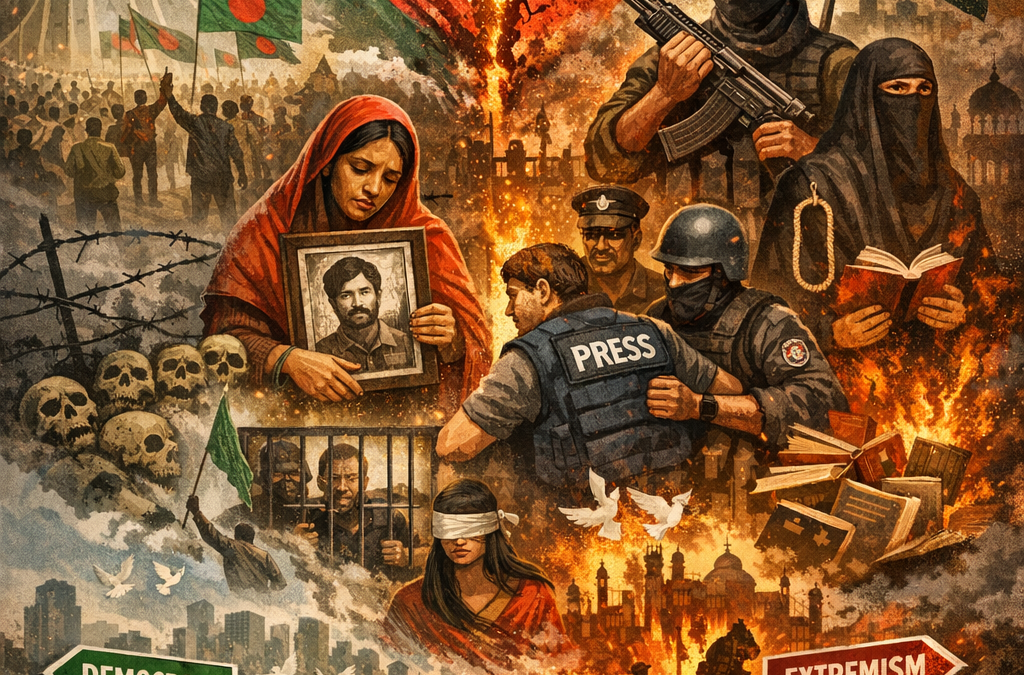
As Bangladesh approaches its forthcoming General Election on 12 February, the atmosphere is not one of democratic celebration, civic optimism, or policy-driven debate. Instead, it feels disturbingly like a moment of national surrender—a quiet, dangerous acquiescence to forces that once stood against the very birth of the republic.
For a nation forged through blood, resistance, and sacrifice, this election raises an uncomfortable question: Has Bangladesh forgotten why it was born?
The growing possibility that Jamaat-e-Islami Bangladesh may emerge as a dominant political force signals not renewal but regression. It represents a reversal of the values that shaped independent Bangladesh in 1971—secularism, pluralism, linguistic nationalism, and social justice.
This is not merely a political contest. It is a struggle for the nation’s moral and historical identity.
From Liberation to Political Amnesia
Bangladesh was born in defiance of religious majoritarianism and authoritarian rule. The Liberation War was not only a territorial struggle—it was a revolt against ideological domination, economic exploitation, and cultural erasure.
Millions died. Countless women were violated. Entire villages were destroyed. Families were displaced. Yet, out of this devastation emerged a republic founded on the promise of equality and secular citizenship.
That promise is now fading.
Half a century later, the country seems willing to elevate forces that opposed independence, collaborated with occupiers, and justified atrocities. This is not reconciliation. It is historical amnesia.
A generation disconnected from lived memory is being fed selective narratives. War crimes are relative. d. Collaborators are rehabilitated. Extremism is repackaged as “moral revival.” And critical history is replaced by emotional propaganda.
What is being lost is not just memory but moral clarity.
The Rise of Political Regression
The current political trajectory reflects a disturbing shift: from civic nationalism to religious absolutism.
Under such an ideological order:
-
Citizenship becomes conditional.
-
Rights become negotiable.
-
Dissent becomes sacrilege.
-
Women’s autonomy becomes controversial.
-
Minorities become invisible.
This is not governance. It is ideological enclosure.
Once religion becomes the organising principle of power, institutions weaken rapidly. Courts hesitate. Media self-censors. Education becomes doctrinal. Bureaucracy becomes politicised. Law becomes selective.
History shows that states that travel this path do not become more ethical or prosperous. They become inward-looking, intolerant, and fragile.
Bangladesh risks following that same trajectory.
Freedom of Speech Under Siege
One of the earliest casualties of ideological politics is freedom of expression.
Already, journalists, bloggers, academics, and activists operate under pressure. Digital laws are weaponised. Criticism is criminalised. “Hurt sentiments” becomes a legal excuse for silencing dissent.
Under an Islamist-dominated political environment, this pressure will intensify.
Questions about governance may be framed as blasphemy. Criticism of leaders may be labelled un-Islamic. Satire may be criminalised. Academic inquiry may be restricted. Cultural production may be monitored.
A society that fears speaking cannot innovate, reform, or heal.
Silence is not stability. It is stagnation.
Religious Freedom: Paradox of Political Islam
Ironically, political Islam rarely produces genuine religious freedom.
When religion is institutionalised by the state, it ceases to be personal and becomes political. Faith becomes regulated. Interpretation becomes centralised. Dissent within religion itself becomes dangerous.
Minority sects are marginalised. Alternative schools of thought are suppressed. Interfaith coexistence weakens. Spiritual diversity shrinks.
Bangladesh has historically been home to Muslims, Hindus, Buddhists, Christians, and indigenous traditions living in relative harmony. That delicate balance now stands threatened.
A politicised religion divides believers into “correct” and “deviant.” It fractures communities and erodes social trust.
True faith flourishes in freedom—not in state enforcement.
The Regional Dimension: A Fragile Neighbourhood
Bangladesh does not exist in isolation. Its political direction directly affects South Asia and Southeast Asia.
Neighbouring India, despite its own internal struggles, remains constitutionally secular and strategically invested in regional stability. It has consistently viewed Bangladesh as a partner in counter-terrorism, trade, and connectivity.
A radicalised Bangladesh would complicate that relationship.
Similarly, historical ties and tensions with Pakistan would acquire new ideological dimensions, potentially reviving old alignments that undermine regional balance.
Southeast Asian states—already grappling with extremism, migration pressures, and security threats—would face new uncertainties.
An ideologically rigid Bangladesh could become:
-
A transit zone for radical networks
-
A breeding ground for extremist narratives
-
A destabilising influence in Bay of Bengal geopolitics
-
A diplomatic liability in global forums
Regional security is not built on slogans. It is built on institutional reliability, moderation, and predictability.
Political extremism weakens all three.
Economic Consequences of Ideological Politics
Ideological governance rarely produces economic competence.
Investors avoid instability. Multinationals avoid reputational risk. Development partners reconsider commitments. Skilled professionals emigrate.
Under radical influence:
-
Women’s workforce participation may decline
-
Education quality may deteriorate
-
Innovation may stagnate
-
International partnerships may weaken
-
Sanctions risks may increase
Bangladesh’s remarkable economic progress over recent decades was driven by pragmatism, openness, and integration with global markets. Ideological rigidity threatens that foundation.
A nation of 200 million cannot survive on rhetoric alone.
The Failure of Secular Leadership
The rise of Islamist politics is not accidental. It reflects the long-term failure of mainstream leadership.
For years, politics has been dominated by
-
Power consolidation
-
Personality cults
-
Corruption scandals
-
Patronage networks
-
Institutional erosion
Policy debates were replaced by vendettas. Reform was sacrificed for control. Accountability was weakened. Merit was sidelined.
In this vacuum, radical forces flourished.
When citizens lose faith in democratic institutions, they seek certainty elsewhere. When justice fails, absolutism becomes attractive. When politics disappoints, dogma seduces.
Jamaat’s resurgence is therefore not just its own achievement—it is the collective failure of secular governance.
Betraying the Martyrs of 1971
What does it mean when a nation honours its martyrs symbolically but betrays them politically?
It means rewriting their sacrifice.
It means telling survivors that their pain is inconvenient.
It means telling history that it is negotiable.
The martyrs did not fight for theocracy. They fought for dignity, language, equality, and freedom.
To empower forces that opposed independence is to dishonour that struggle.
No monument can compensate for moral surrender.
Cultural Erosion and Identity Crisis
Bengali identity has always been pluralistic—rooted in language, literature, music, and shared history.
Tagore, Nazrul, Lalon, and Jasimuddin—these traditions transcended religious boundaries. They celebrated humanity over dogma.
Ideological politics threatens this cultural ecosystem.
Art becomes suspect. Literature becomes monitored. Cinema becomes censored. Festivals become politicised.
A culture that cannot breathe cannot inspire.
Without creative freedom, societies become emotionally impoverished.
A Question of National Soul
Nations do not collapse overnight. They decay gradually.
First, institutions weaken.
Then, memory fades.
Then, fear spreads.
Then, conformity prevails.
Eventually, people stop asking questions.
That is how souls are lost.
Bangladesh is approaching that threshold.
The issue is not whether one party wins or loses. The issue is whether democratic consciousness survives.
What Future for 200 Million Bengalis?
If current trends continue, Bangladesh may face:
Politically:
-
Shrinking civic space
-
Criminalisation of dissent
-
Ideological governance
Socially:
-
Marginalisation of minorities
-
Retreat of women
-
Polarised communities
Economically:
-
Capital flight
-
Brain drain
-
Reduced competitiveness
Strategically:
-
Diplomatic isolation
-
Security vulnerabilities
-
Regional mistrust
Culturally:
-
Erosion of pluralism
-
Intellectual stagnation
-
Creative decline
This is not destiny. It is a choice.
A Final Warning
History will judge this moment.
Not by speeches.
Not by slogans.
But by consequences.
Future generations will ask:
Why did you abandon secularism?
Why did you trade freedom for sentiment?
Why did you forget 1971?
Why did you tolerate regression?
And there will be no easy answers.
Conclusion: Defend the Republic, Not the Illusion
This election is not about left versus right.
It is about memory versus amnesia.
Republic versus regression.
Pluralism versus absolutism.
Bangladesh still has time.
Time to remember.
Time to resist.
Time to reform.
Time to reclaim its democratic soul.
But time is running out.
For 200 million Bengalis, the question remains stark:
Will Bangladesh walk forward as a confident republic—
or backward into ideological captivity?
The answer will define the nation for generations.