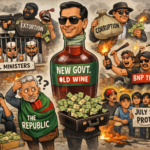

Bangladesh stands on the threshold of a pivotal electoral moment. The general election scheduled for 12 February 2026 is being framed as the country’s first genuine democratic reset following the 2024 uprising that ended the long tenure of Sheikh Hasina. Yet beneath the rhetoric of reform and renewal lies a troubling question: is Bangladesh moving toward a free and fair election—or merely exchanging one form of political management for another?
This election is unprecedented in several respects: it will be held under an interim administration led by Muhammad Yunus, it will exclude the Awami League pending trials, it will restore electoral space to Jamaat-e-Islami, and it will introduce postal voting for expatriates. Alongside the parliamentary contest, a constitutional referendum—the “July Charter”—will seek public approval for far-reaching state reforms.
Individually, these elements could signal progress. Collectively, they raise concerns about selective permissiveness, uneven enforcement, and institutional bias—conditions that risk substituting legitimacy with choreography.
The Interim Government: Neutral Arbiter or Interested Manager?
The interim government’s mandate is clear: stabilize the polity, reform institutions, and deliver a credible election. However, neutrality is not declared; it is demonstrated. Since August 2024, the administration has made decisions that materially reshape the political field—most notably the continued ban on the Awami League, the rapid reintegration of Jamaat-e-Islami into electoral politics, and the facilitation of a new political actor, the National Citizen Party.
The problem is not reform; it is asymmetry. When one party remains excluded pending open-ended legal processes, while others enjoy expedited access to media, assembly, and administrative goodwill, the referee risks becoming a participant. The perception—widely aired across radio, television, and print—is that state tolerance is being distributed unevenly.
The Election Commission: Credibility on Trial
At the centre of electoral integrity sits the Election Commission of Bangladesh. Its performance will determine whether February 2026 is remembered as a democratic correction or a procedural exercise with a foregone conclusion.
Persistent concerns include:
-
Voter roll accuracy, particularly in minority and opposition-leaning areas.
-
Campaign regulation enforcement, including selective policing of rallies.
-
Administrative neutrality at district and upazila levels.
-
Adjudication of complaints with speed and transparency.
The Commission’s challenge is compounded by its operating environment: an interim executive that is itself politically consequential, and a security apparatus conditioned by decades of politicised deployment. Credibility cannot be restored by process alone; it requires visible even-handedness.
Key Contenders and the Tilted Field
Bangladesh Nationalist Party (BNP)
The Bangladesh Nationalist Party enters the race as the presumptive front-runner. The return of Tarique Rahman after 17 years in exile has galvanised the party’s base and consolidated its organisational advantage. BNP’s nationwide networks, electoral muscle, and narrative of victimhood under the previous regime position it strongly.
Yet front-runner status carries responsibility. A landslide achieved in a skewed contest will be a hollow mandate—strong in seats, weak in legitimacy.
Jamaat-e-Islami
The re-entry of Jamaat-e-Islami marks a seismic shift. Once barred under a secular constitutional framework, Jamaat now operates with renewed institutional tolerance. Reports of favourable treatment—lenient policing of rallies, disproportionate media visibility, and permissive administrative oversight—have fuelled allegations of quiet rehabilitation.
The concern is not participation per se; it is preferential normalisation without a transparent reckoning with past conduct. Democracies do not launder history through silence.
National Citizen Party (NCP)
The National Citizen Party, born of the 2024 student movement, embodies generational aspiration. Yet its rapid ascent—access to platforms, donors, and favourable coverage—has prompted questions about state patronage. When a nascent party accelerates faster than organisational gravity allows, scrutiny is warranted.
Awami League
The exclusion of the Awami League—regardless of one’s assessment of its record—poses the gravest challenge to electoral completeness. Bans pending trials risk becoming indefinite political quarantines. Justice delayed becomes justice politicised; democracy diminished by exclusion is democracy in name only.
Media, Money, and the Machinery of Influence
Election integrity is not determined solely on polling day. It is shaped in newsrooms, social platforms, and donor circuits. Independent journalists report editorial slants, differential advertising access, and algorithmic amplification that favour certain actors. The information environment—already polarised—now appears curated.
Campaign finance transparency remains inadequate. Without real-time disclosure and enforcement, money fills the gaps left by rules. Where oversight is weak, patronage substitutes for persuasion.
Security and the Chilling Effect
A free election requires voters to feel safe—not merely on election day, but throughout the campaign. Selective enforcement, preventive detentions, and uneven crowd control create a chilling effect. Fear does not need to be universal to be effective; it only needs to be targeted.
International Observation: Necessary but Not Sufficient
The presence of the European Union through an European Union Election Observation Mission is welcome. Observers can deter the crudest abuses and document irregularities. But they cannot substitute for domestic political will. Elections fail when institutions collude, hesitate, or rationalise.
The Referendum Question: Reform or Distraction?
The “July Charter” referendum promises to curb executive overreach and strengthen judicial independence. These goals are laudable. Holding such a consequential vote alongside a high-stakes election, however, risks conflation. Reform requires deliberation; referenda require clarity. Bundling them invites confusion—and opportunistic mobilisation.
So, Will the Election Be Free and Fair?
Free? Partially.
Fair? Doubtful—unless immediate corrective measures are taken.
The prevailing pattern suggests a managed transition: less overtly coercive than 2024, more plural than before, yet structurally tilted. If one party is excluded, another rehabilitated without reckoning, and a third fast-tracked with institutional indulgence, the outcome may be competitive but not equitable.
Who Is Likely to Sweep the Slate Clean?
On present trajectories, the BNP is best positioned to secure a parliamentary majority—potentially a commanding one—benefiting from organisational reach, voter fatigue with the past, and a fragmented opposition. Jamaat-e-Islami is likely to convert tolerance into seats in select constituencies. The NCP may perform strongly in urban pockets but lacks nationwide depth. The Awami League’s absence will inflate margins and deflate legitimacy.
A “sweep” under these conditions will not close Bangladesh’s democratic chapter; it will open a new contest over credibility.
What Must Change—Now
-
Time-bound legal clarity on party participation.
-
Uniform enforcement of campaign rules and public-order laws.
-
Transparent media and finance regulation, with penalties.
-
Independent complaint adjudication with published decisions.
-
Security neutrality is monitored domestically and internationally.
Without these, February 2026 risks becoming a procedural success and a democratic failure.