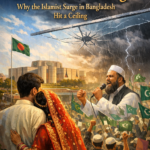
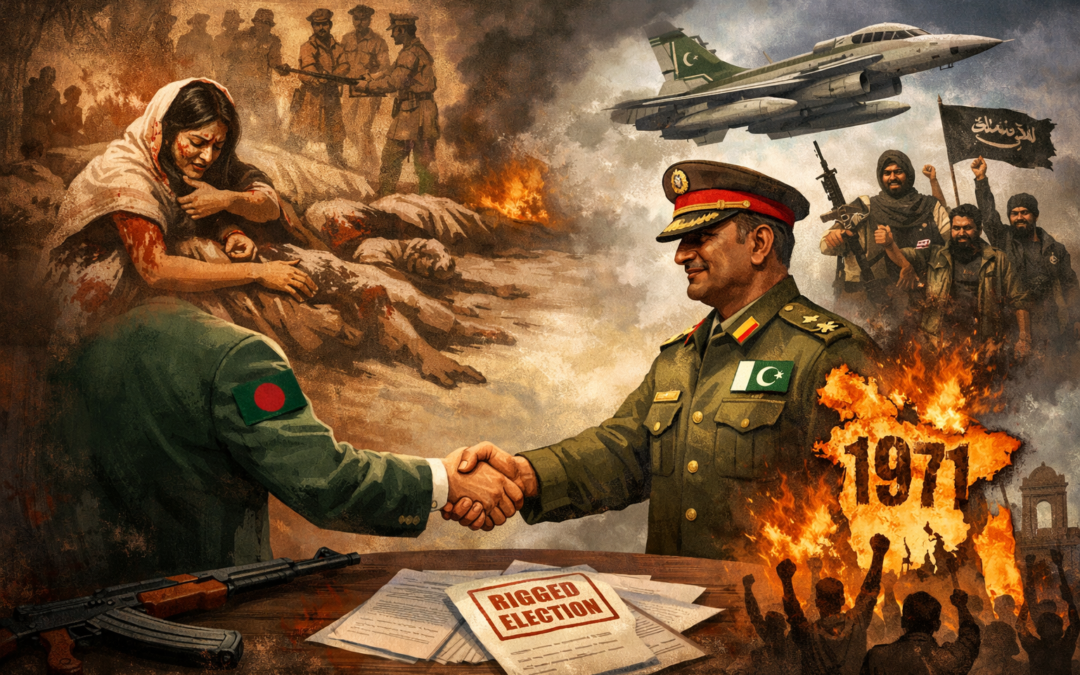
There are moments when a nation does not simply make bad policy choices—it repudiates its own origin story. Bangladesh is living through such a moment.
The present regime’s sudden embrace of Pakistan—the very state that carried out genocide on Bangladeshi soil in 1971—is not diplomacy. It is desecration.
Pakistan butchered Bangladesh into existence. Three million dead. Women used as instruments of war. Intellectuals executed in the final days to cripple a future nation. And yet, today, Dhaka smiles, signs defence deals, buys fighter planes, and speaks of “cooperation,” as though history were a minor inconvenience.
This is not reconciliation. It is surrender without truth.
When the Victim Courts the Perpetrator
Pakistan has never apologised for 1971. It has never acknowledged the scale of its crimes. Instead, it has denied, distorted, and defended the actions of the same military institution that still dominates its politics.
For Bangladesh to now arm itself through Pakistan is to normalise genocide denial at the level of state policy. It sends a chilling message: that mass atrocity has no lasting consequences, that memory is expendable, and that justice is optional when power is at stake.
What does this say to survivors? To the families of martyrs? To a generation taught that independence was sacred?
Importing Instability, Exporting Principle
Pakistan’s geopolitical legacy is not stability but perpetual conflict. Its military thrives on crisis, proxy warfare, and ideological extremism. Aligning with such a state does not enhance Bangladesh’s security—it corrodes it.
At a time when Bangladesh should be focusing on climate survival, economic equity, and democratic consolidation, it is instead flirting with a security paradigm built on confrontation. Even worse, this posture risks destabilising relations with neighbouring India, whose support during the Liberation War was decisive.
History offers a clear lesson: states that abandon principled diplomacy in favour of militarised alliances rarely control the consequences.
Rehabilitating the Traitors of 1971
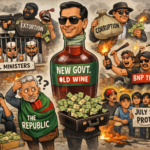
The foreign policy shift cannot be separated from what is unfolding domestically. Bangladesh is heading toward a carefully engineered election—one designed not to empower citizens but to install a compliant order.
At the centre of this project is the political rehabilitation of a radical Islamist outfit whose predecessors collaborated with the Pakistan Army during the genocide. These were the men who opposed independence, justified mass murder, and branded freedom fighters as enemies of Islam.
Today, they are being welcomed back into relevance.
This is not political pragmatism. It is historical obscenity.
A Nation on a Collision Course with Its Own Conscience
Bangladesh was not born merely to change flags. It was born to reject militarised theocracy, ethnic erasure, and authoritarian rule. The Liberation War was a moral revolt as much as a military one.
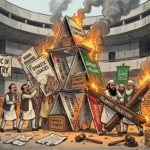
By empowering the ideological heirs of collaborators, cosying up to Pakistan without justice, threatening regional stability, and hollowing out elections, the regime is steering Bangladesh toward a head-on collision with its own destiny.
No amount of propaganda can erase 1971. No engineered mandate can silence collective memory. History has a way of returning—often with consequences far harsher than those avoided in the present.
The World Must Not Look Away
This is not just Bangladesh’s internal affair. It is a test case for whether genocide memory, democratic legitimacy, and moral accountability still matter in international politics.
If the betrayal of a liberation struggle can be rewarded with silence, then the promise of “Never Again” becomes meaningless everywhere.
Bangladesh’s future is being gambled away. And when the reckoning comes, it will not ask who held power—only who chose to forget.