Eid Should Be a Journey of Joy, Not a National Gamble With Death
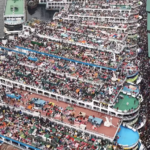
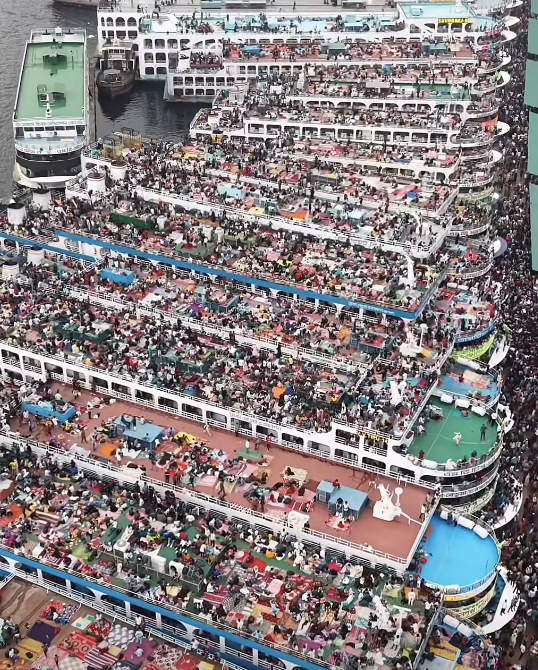
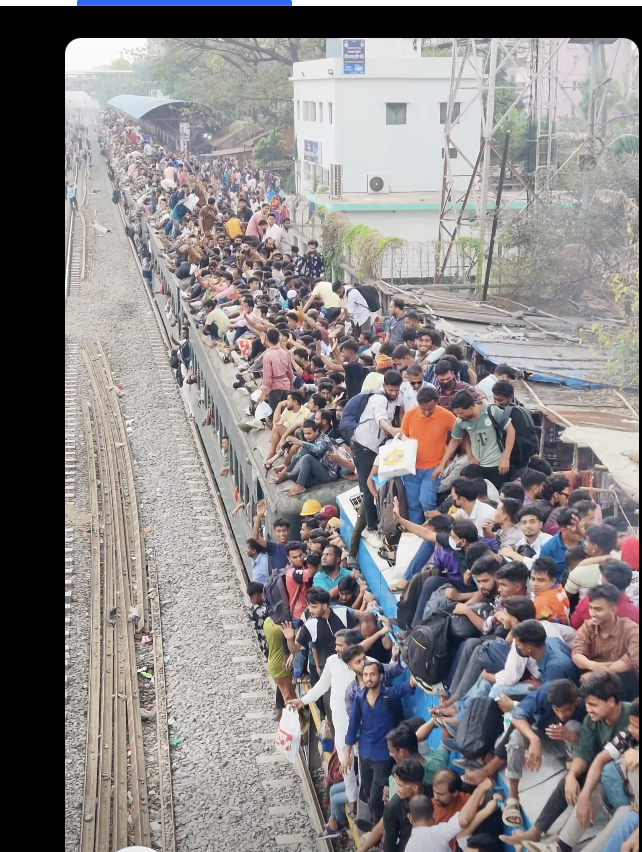
Every year in Bangladesh, as the holy Eid approaches, an exodus begins. Millions of people leave Dhaka and other cities to return to their villages, towns, and ancestral homes to embrace parents, children, siblings, and loved ones. It should be one of the most beautiful movements of human affection in the country: a homecoming of faith, family, memory, and belonging. Instead, fit becomes, ar too often, ine of the most dangerous mass migrations in South Asia. This year is no different. Reports from Dhaka and across the transport network show overcrowded trains, passengers riding on roofs, severe shortages of buses and launches, inflated fares, long traffic snarls, and fresh transport accidents right in the middle of the Eid rush.
What sort of republic forces its citizens to risk life and limb so spend Eid with their families?
Look at the annual spectacle. People are packed into trains like freight. Men cling to carriage doors. Others sit on train roofs as if human life in Bangladesh has become so cheap that the railway lines themselves are now an altar of neglect. Reports this week described exactly that: jam-packed trains leaving Kamalapur, passengers riding on rooftops, and authorities struggling to maintain safety under crushing demand.
And it is not just the railways. The bus sector is equally grim. Passengers have faced overcharging, overcrowding, and arbitrary fare hikes. The Business Standard reported that even BRTC buses were found carrying passengers beyond seat capacity, with extra riders seated on stools,. At the same time, transport syndicates were accused of driving up fares for Eid profits. bdnews24 likewise reported that homebound travellers were being battered by”gridlock and “”ky-high fares”.
Then there are the waterways. Even there, tragedy has intruded into the holiday movement. The Financial Express reported that a collision between two passenger launches at Sadarghat on 18 March left two people dead and two others missing just as thousands were leaving the capital for Eid.
This is not a transport system. It is an annual ritual of state failure.
The current government cannot hide behind press briefings, photo opportunities, or administrative notices. Yes, the police issued Eid travel safety guidelines. Yes, the authorities announced restrictions on trucks, covered vans, and lorries on highways from 17 to 23 March. Yes, railway officials spoke of schedule discipline, extra coaches, and preparations. But what matters is not the press release; it is the lived reality of the citizen. And that lived reality, once again, is one of panic, discomfort, danger, extortion, and uncertainty.
This is why the public anger matters. The promises were lofty. The slogans were grand. Th” rheto”ic of “change” was intoxicating. Bangladesh was told that a new era of governance was dawning after the upheaval of 2024 and the 2026 election. Reuters reported that Prime Minister Tarique Rahman came to office pledging price stability, rule of law, and governance refBNP’sfter the BNP’s sweeping election victory and the political transition that foHasina’sheikh Hasina’s ouster.
But what does the ordinary citizen see today? Not reform. Not ordered. Not a humane state. They see the same old Bangladesh: broken systems, unregulated greed, weak enforcement, dangerous overcrowding, and an official culture that reacts after the crisis rather than preventing it before it begins. They see a government that appears capable of winning power but not yet capable of governing the republic.
That is the central indictment.
Because Eid travel chaos in Bangladesh is not some unforeseeable natural disaster. It is annual. Predictable. Measurable. Anticipated months in advance. Every government knows it is coming. Every ministry knows it is coming. Every police officer, transport regulator, railway administrator, and district official knows it is coming. Yet year after year, the same pictures return: desperate passengers, roof-riding commuters, highway paralysis, transport profiteering, and grieving families. When failure repeats itself in exactly the same form, it is no longer an accident. It becomes a structure of neglect.
And the broader national question cannot be avoided. If a government cannot secure a basic holiday journey for its citizens during the holiest festive season, what confidence can people have in its larger promises of justice, democracy, institutional stability, and national renewal? If the state cannot protect the worker going home to Rangpur, the mother travelling to Barisal, the student boarding a train for Sylhet, or the day labourer hanging from the footboard of an overloaded coach, then what exactly is this government protecting?
Power?
Narrative?
Vengeance against political opponents?
Many Bangladeshis will reasonably ask whether the real project was governance at all or simply the toppling of one political force and the installation of another. That question is not born of conspiracy; it is born of lived disappointmpublic’sn the public’s suffering remains fundamentally unchanged, people begin to suspect that only the faces at the top have changed, while the machinery of indifference below remains intact.
The pain is deeper because Eid is not an ordinary holiday. It is sacred. It is emotional. It is civilisational. It is the one time when the garment worker, the office clerk, the rickshaw-puller, the banker, the student, and the expatriate dream the same dream: to go home. To sit with family. To pray together. To eat together. To remember that beyond politics and poverty, they still belong to one another. A decent state would honour Bangladesh’s. Bangladesh’s state, too often, exploits it.
This dilemma is not merely a transport issue. It is a moral issue. It is a question of whether the citizen is treated as a human being or as disposable cargo.
Road safety data make the situation even more WHO’sing. The WHO’s Bangladesh road-safety profile puts estimated road traffic deaths at roughly 31,578 in 2021, underscoring thecountry’s the country’s systemic transport danger, while recent analysis has highlighted how official figures often understate the true death toll.
So this Eid, Bangladeshis travel not with confidence but with prayer. Instead of travelling with trust, they travel with fear. Not because the country is poor in spirit, but because it is still too poorly governed.
The people deserve better than being crushed into compartments, fleeced at terminals, stranded in gridlock, or thrown onto the mercy of fate just to celebrate a sacred festival.
Eid should be a reunion. In Bangladesh, it still too often resembles an evacuation.
And that is a national shame.
References
-
Reuters on Bangladesh’s 2026 election, BNP victory, and Tarique Rahman taking office.
-
Reports on Eid overcrowding, passengers riding train roofs, and pressure at Kamalapur.
-
Reports on fare overcharging, overcrowded buses, and Eid gridlock.
-
Financial Express report on launch collision during Eid rush.
-
Police safety guidelines and restrictions on trucks/lorries during Eid travel.
-
WHO and road-safety profile data on Bangladesh’s road traffic mortality burden.
I can also turn this into a sharper newspaper-style op-ed or a Bengali version.