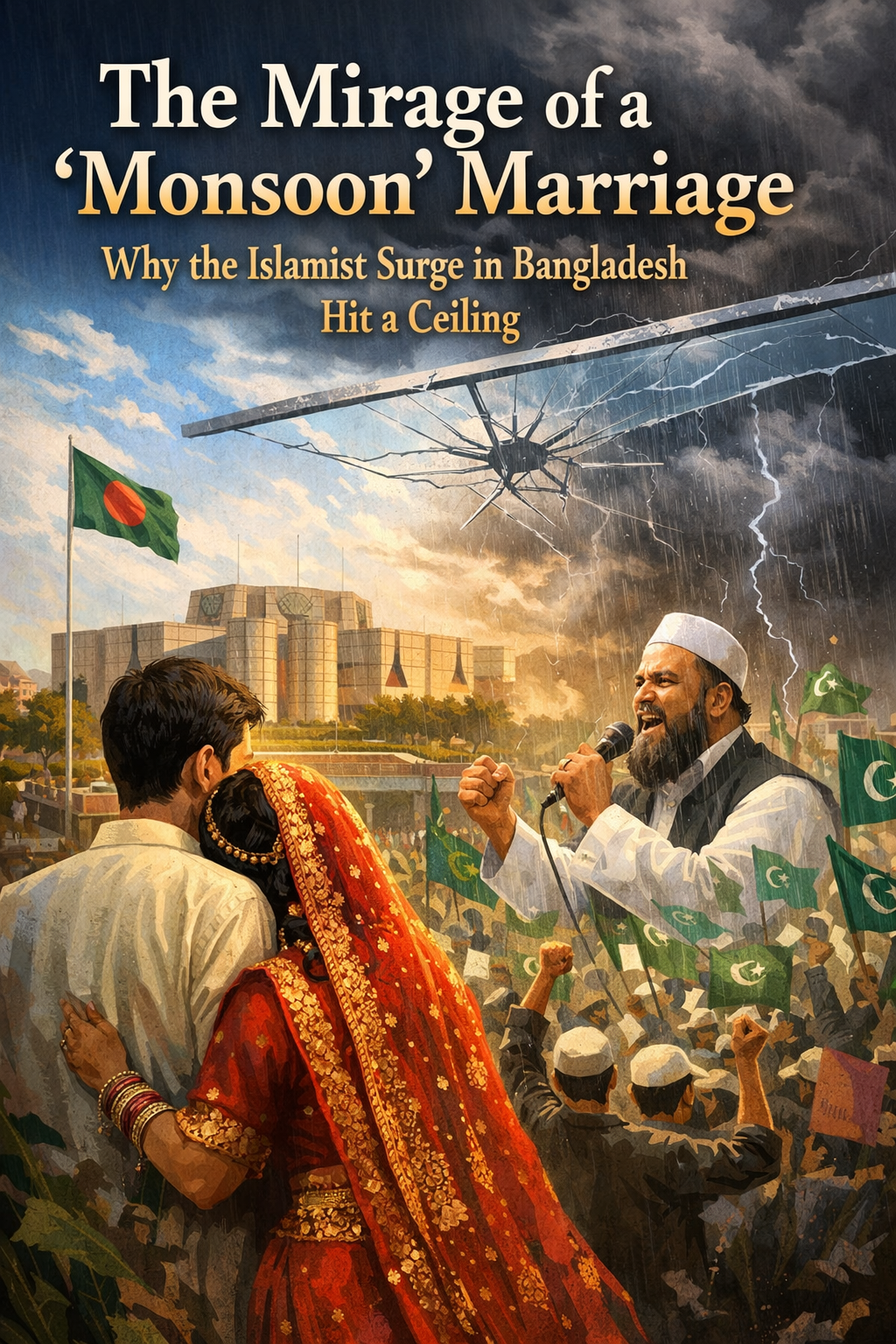
 The Mirage of a “Monsoon” Marriage: Why the Islamist Surge in Bangladesh Hit a Ceiling
By South Asia Corner Editorial Staff
The dust has finally begun to settle on the 2026 general elections, and the landscape of the “New Bangladesh” is far from what the firebrand clerics and street-level agitators had envisioned during the heady, chaotic days of August 2024. For months, a narrative was meticulously spun: that the “Monsoon Revolution” was not merely a rejection of Sheikh Hasina’s autocracy but a mandate for a radical ideological pivot toward political Islam.
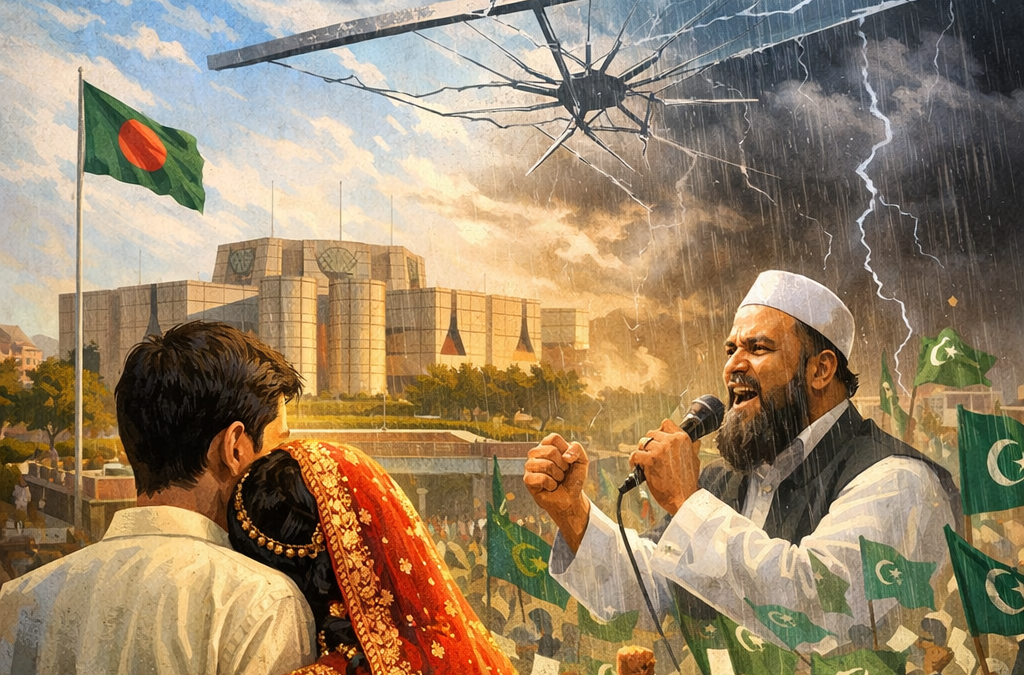
But as the ballots were counted and the seat shares finalised, that narrative didn’t just crack—it shattered. The expected “marriage of convenience” between the populist interim forces and the Islamist hardliners has proven to be a mirage. Instead, what we are witnessing is a cold, calculated reassertion of the “Deep State” and a rare alignment of global superpowers that has effectively left the pro-Islamist camp out in the cold.
The Myth of the Mandate
In the immediate aftermath of the July uprising, groups like Jamaat-e-Islami and their younger, more aggressive offshoots acted as if they owned the revolution. They capitalised on the vacuum left by the fleeing Awami League, filling the streets with rhetoric that equated “true” sovereignty with a religious overhaul of the state.
However, they fundamentally misread the room. The Gen-Z protesters who braved the bullets of the Chhatra League were fighting for Insaaf (justice) and Adhikar (rights), not a theocratic experiment. When the interim government under Muhammad Yunus introduced the “July Charter”—a blueprint for a bicameral legislature and proportional representation—it wasn’t a gift to the Islamists; it was a cage. By institutionalising pluralism, the interim administration ensured that no single ideological fringe could hijack the state.
The Deep State’s Quiet Veto
If the Islamists were the “loud” power in 2024, the Bangladesh military and the civil bureaucracy remained the “quiet” power. Behind the scenes, the security establishment—the real “Deep State”—made it clear that while they were pleased to see Hasina gone, they had zero appetite for a Kabul-style transformation in Dhaka.
The military’s leadership, historically wary of radicalism that threatens international defence cooperation and internal stability, acted as a stabiliser. They didn’t need to launch a coup; they simply ensured that the electoral process remained “refined.”. By supporting the participation of moderate, “clean-image” technocrats and keeping the BNP (Bangladesh Nationalist Party) as the primary centrist gravitational force, the Deep State effectively diluted the Islamist surge.
The Superpower Consensus: An Unlikely Handshake
Perhaps most scathing for the pro-Islamist camp was the realisation that they had no friends in high places. Washington, New Delhi, and Beijing, in a rare moment of geopolitical synchronicity, found themselves in agreement: a stable, predictable, and non-radical Bangladesh is an uncompromising requirement.
- Washington: Despite the shift in administrations, the U.S. remains focused on the “Indo-Pacific Strategy”. A radicalised Dhaka would be a black hole for regional security.
- Beijing: China, now the biggest beneficiary of the transition with its $23 billion export deals and Mongla Port projects, has no interest in an unpredictable religious regime that might jeopardise its Belt and Road investments.
- New Delhi: While initially stung by Hasina’s fall, India has pivoted to a “cautious recalibration”, preferring the secular-nationalist framework of the BNP over any Islamist alternative.
A Scathing Reality Check
The 2026 results show a landslide for the BNP and a respectable but limited showing for the Islamist-NCP (National Citizen Party) alliance. The “marriage” failed because the bride and groom were never compatible. The Islamists wanted a revolution; the people wanted a restoration of dignity and a functional economy.
The fall of the pro-Islamist takeover wasn’t a result of a lack of passion but a lack of pragmatism. They attempted to construct a fragile structure on the unstable ground of a student protest, only to discover that the foundations of the Bangladeshi state, supported by its army, global allies, and its moderate majority, are far more robust than they initially anticipated.
The “New Bangladesh” is indeed here. But it looks less like a caliphate and more like a messy, vibrant, and decisively centrist democracy that, for now, has successfully exorcised the ghosts of radicalism, demonstrating a commitment to pluralism and inclusive governance that appeals to a broad spectrum of the population.