 The New Dhaka: A Republic of Fragile Zealotry
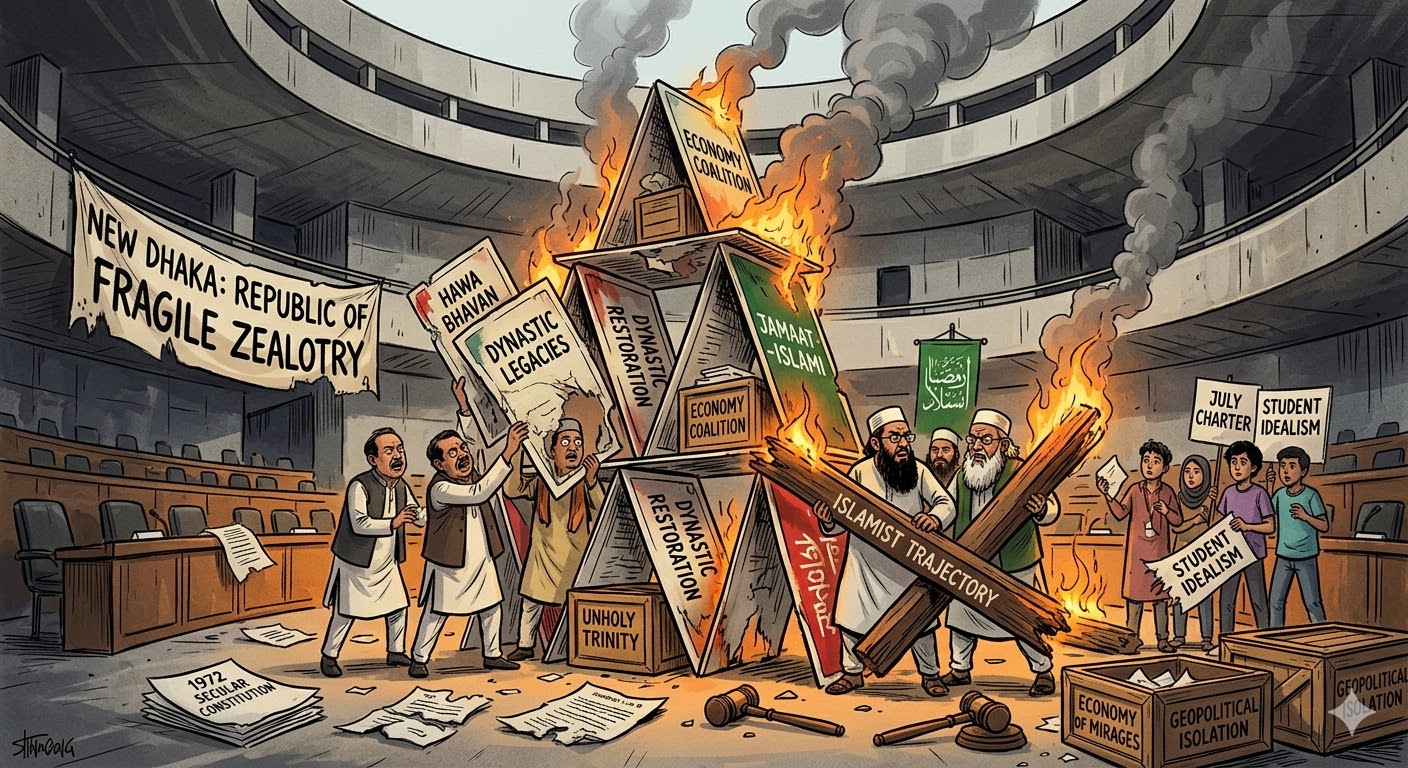
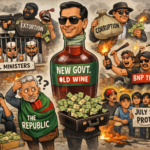
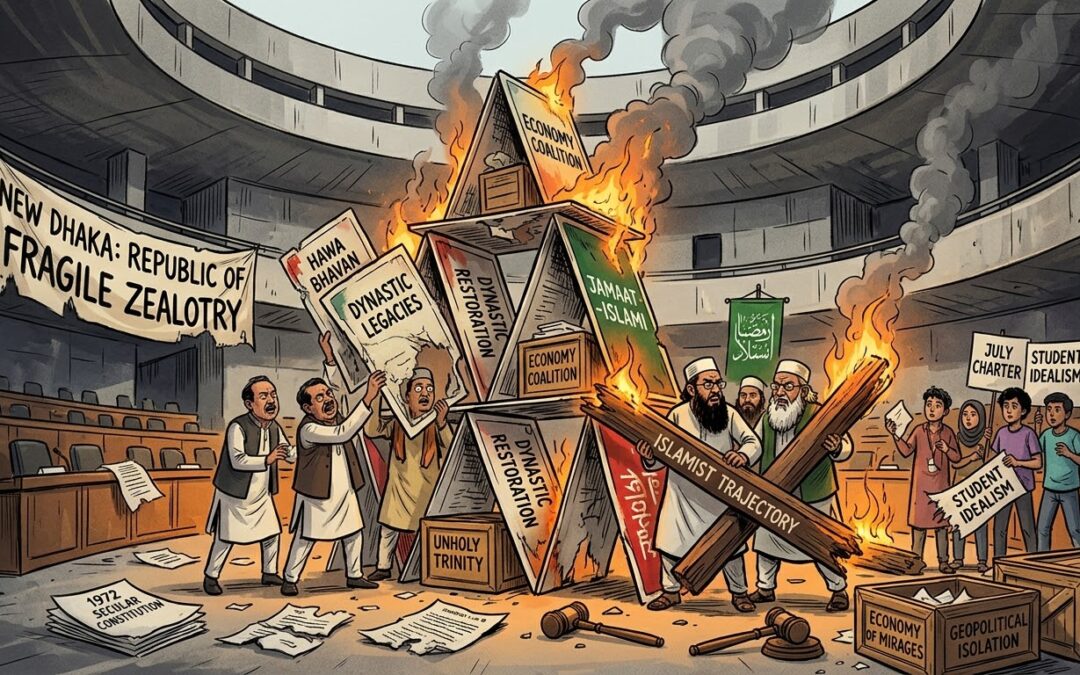
Welcome to the “New Bangladesh”, where the dust of the 2024 uprising hasn’t so much settled as it has been swept into a pile and ignited. Following the February 2026 elections—a “bipolar” contest where the only real competition was between the far-right and the further-right—the Jatiya Sangsad has been transformed into a theatre of the absurd.
At the centre of this circus sits the Bangladesh Nationalist Party (BNP), returning to power after two decades of exile and irrelevance. Their return isn’t just a political comeback; it’s a restoration of a dynastic ghost. Leading the charge is Tarique Rahman, a man whose resume reads more like a rap sheet than a statesman’s CV. Once a fugitive in London, Tarique has traded his “convicted bomb blaster” tag—earned for his role in the 2004 grenade attack aimed at obliterating the Awami League leadership—for the title of Prime Minister. It is a grim irony that a nation that rose up against authoritarianism has handed the keys to a man whose previous tenure was defined by “Hawa Bhavan” corruption and state-sponsored terror.
The Unholy Trinity
The BNP doesn’t sit alone. To their right—if such a thing is even possible—sits the Jamaat-e-Islami, the “kingmakers” who didn’t even need the crown. By securing nearly 70 seats, Jamaat has successfully laundered its reputation. By hitching their wagon to the National Citizen Party (NCP)—an offshoot of the July student movement—they have used “Gen Z” idealism as a Trojan horse.
The NCP, once the darling of the secular reformists, has essentially become a “radical-lite” garnish for the Islamist main course. Their “July Charter” is less a democratic roadmap and more a slow-motion funeral for the secular 1972 Constitution.
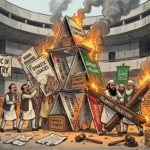
A House of Cards on Fire
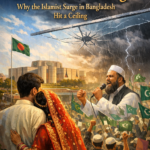
Is this Islamist trajectory sustainable? Scepticism isn’t just a mood; it’s a mathematical necessity. Bangladesh’s current stability is built on three deeply cracked pillars:
-
The Economy of Mirages: Tarique Rahman has promised 10 million jobs and “clean politics”. This is coming from a party historically known for extortion and a prime minister who spent 17 years avoiding the Bangladeshi justice system.
-
Geopolitical Isolation: By pivoting toward a “Bangladesh First” policy—a thinly veiled euphemism for distancing from India and cosying up to Pakistan and Türkiye—the government is playing a dangerous game. Bangladesh’s garment-led economy relies on global trade routes that don’t take kindly to “radical mollahs” dictating social policy.
-
The Inevitable Infighting: The alliance between the BNP and the Jamaat-NCP bloc is a marriage of convenience, not conviction. The BNP wants absolute power; the Islamists want a Sharia-compliant state. Eventually, Tarique’s nationalist ego will collide with the theological purity of the Jamaat.
The Verdict
The Awami League has been banned, its leaders are in exile or in cages, and the “opposition” is now just a more extreme version of the government. By erasing the secular centre, Bangladesh has removed the only guardrails it had.
Sustainable? Hardly. What we are witnessing isn’t the birth of a “Second Republic“, but the cannibalisation of a nation’s future by its most regressive elements. When the revolutionary fervour of 2024 finally fades into the reality of 2026—marked by rising food prices and shrinking personal freedoms—the people of Bangladesh may realise they haven’t toppled a dictator; they’ve simply replaced a “Begum” with a “Bomber” and his choir of radicals.