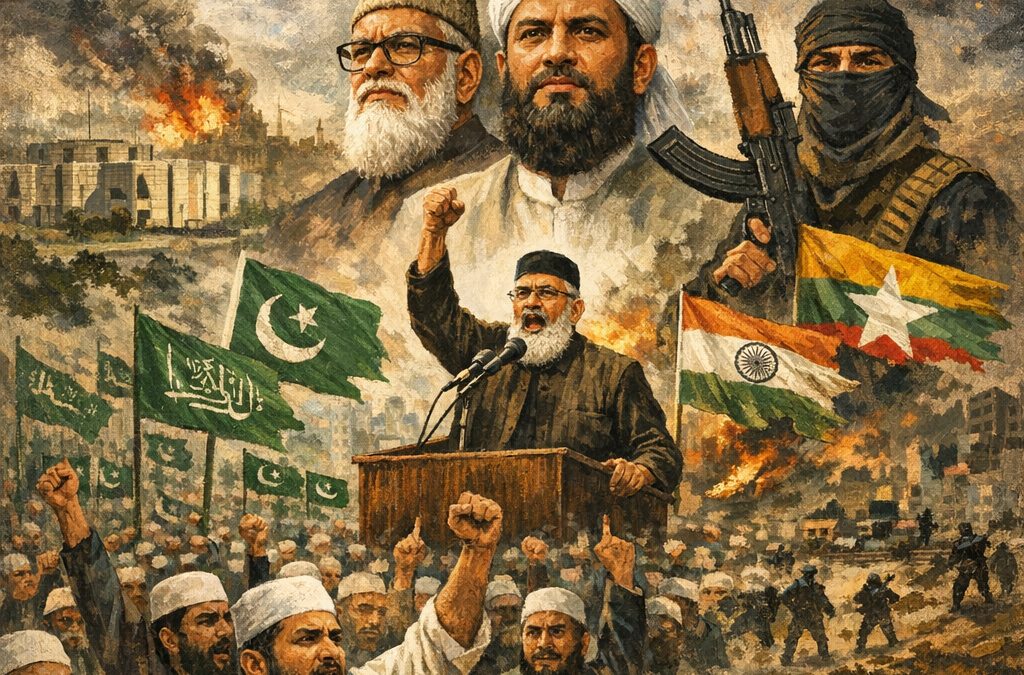
The re-emergence of Jamaat-e-Islami in Bangladesh is not merely a domestic political development—it is a signal flare for the entire Indian subcontinent. Long relegated to the margins after Bangladesh’s war crimes trials and popular rejection of 1971 collaborators, Jamaat’s gradual rehabilitation raises uncomfortable questions: has history begun to reverse itself, and at what cost to regional stability?
To understand the danger, one must first understand Jamaat-e-Islami’s ideological DNA. Jamaat is not a conventional political party; it is a transnational Islamist movement rooted in the writings of Abul A’la Maududi, advocating the replacement of secular democratic systems with a theocratic Islamic state. In Bangladesh, its role during the 1971 Liberation War—actively collaborating with the Pakistani military and participating in mass atrocities—rendered it morally and politically toxic for decades. That stigma is now eroding.
The Conditions Behind Jamaat’s Resurgence
Jamaat’s revival is occurring within a familiar historical pattern: political vacuum, institutional fatigue, and public disillusionment with mainstream parties. When democratic competition weakens and governance becomes transactional rather than visionary, ideological movements step in offering “moral order” and identity politics.
Jamaat has been particularly adept at exploiting grassroots networks—mosques, madrasas, welfare charities, and student wings—to rebuild influence quietly rather than through overt electoral dominance. This long-game strategy mirrors Islamist movements elsewhere, from Turkey to Pakistan, where cultural capture precedes political control.
What makes this resurgence dangerous is not Jamaat’s current parliamentary strength, but its ability to normalize ideas that once stood outside the constitutional framework of Bangladesh: questioning secularism, relativising the crimes of 1971, and reframing national identity away from linguistic nationalism toward religious exclusivism.
Bangladesh–Pakistan Rapprochement: Symbolism Matters
The renewed warmth between Dhaka and Islamabad must be viewed through this ideological lens. While states routinely recalibrate foreign relations, symbolism in South Asia carries historical weight. Pakistan has never formally apologised for the genocide of 1971. Any sudden proximity, especially without truth or reconciliation, risks legitimising historical revisionism.
For Jamaat and its ideological allies, closer ties with Pakistan represent more than diplomacy—they represent vindication. Pakistan was not merely a former adversary; it was the patron state of Jamaat’s political project in East Pakistan. Renewed alignment, even if pragmatic on the surface, energises forces that never accepted Bangladesh’s secular foundations.
Is This a Tangible Threat to India?
For India, the concern is not invasion or conventional war. The threat is subtler, and therefore more dangerous.
First, there is the security dimension. Islamist radicalisation in Bangladesh historically correlates with cross-border militancy, particularly in India’s eastern and northeastern states. Past decades have shown how porous borders combined with ideological radicalism create safe corridors for extremist networks.
Second, there is the geopolitical dimension. A Bangladesh ideologically drifting toward Pakistan—and by extension closer to certain Gulf and global Islamist currents—complicates India’s eastern security calculus. It risks turning a historically friendly neighbour into a strategic grey zone, vulnerable to influence from actors hostile to India’s regional interests.
Third, there is the civilisational dimension. Bangladesh’s secular, pluralistic identity has long served as a counter-narrative to Pakistan’s religion-first nationalism. If that model weakens, it emboldens similar forces across the subcontinent, reinforcing the idea that South Asia’s future lies in religious absolutism rather than coexistence.
Is the Threat Inevitable?
No—but complacency would be fatal.
Bangladesh still possesses powerful antibodies: a strong memory of 1971, a vibrant civil society, cultural nationalism rooted in language and literature, and a population that has repeatedly rejected theocratic rule when confronted directly. Jamaat thrives not when it wins arguments, but when silence replaces resistance.
For India, the answer lies not in paranoia or coercion, but in sustained engagement—economic, cultural, educational, and diplomatic. Alienating Bangladesh would only push it toward ideological hardliners. Supporting democratic institutions and people-to-people ties remains the most effective long-term strategy.
Conclusion
The rise of Jamaat-e-Islami in Bangladesh is not yet an existential threat—but it is a warning. History in South Asia has shown that ideological fires, once ignored, rarely stay contained within borders. The subcontinent stands at a familiar crossroads: between pluralism and dogma, memory and amnesia, democracy and divine entitlement.
Whether this moment becomes a footnote or a turning point depends on how seriously the region chooses to remember its past—and defend its future.