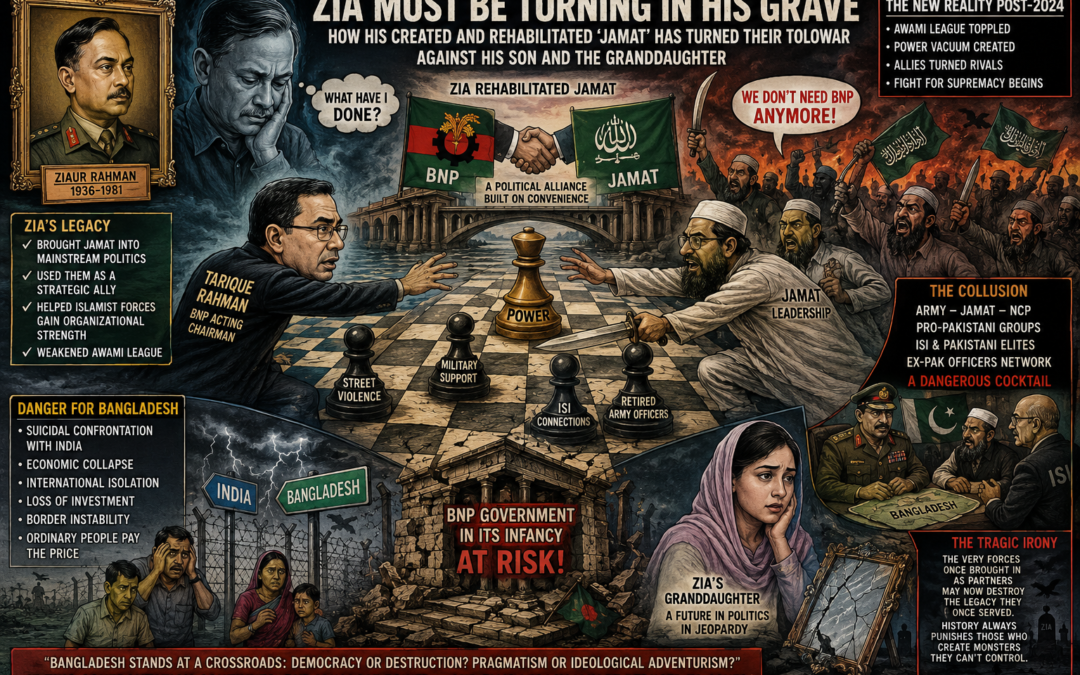
For decades, the political narrative of the Bangladesh Nationalist Party rested upon a strategic alliance forged during the military and post-military eras between the BNP and Bangladesh Jamaat-e-Islami. The relationship was not merely electoral; it was ideological, organisational, and deeply embedded within parts of the state machinery. Zia rehabilitated political Islam into mainstream politics after the post-1971 secular experiment. Jamaat, which had been politically marginalised after independence, found space once again within Bangladesh’s evolving political landscape.
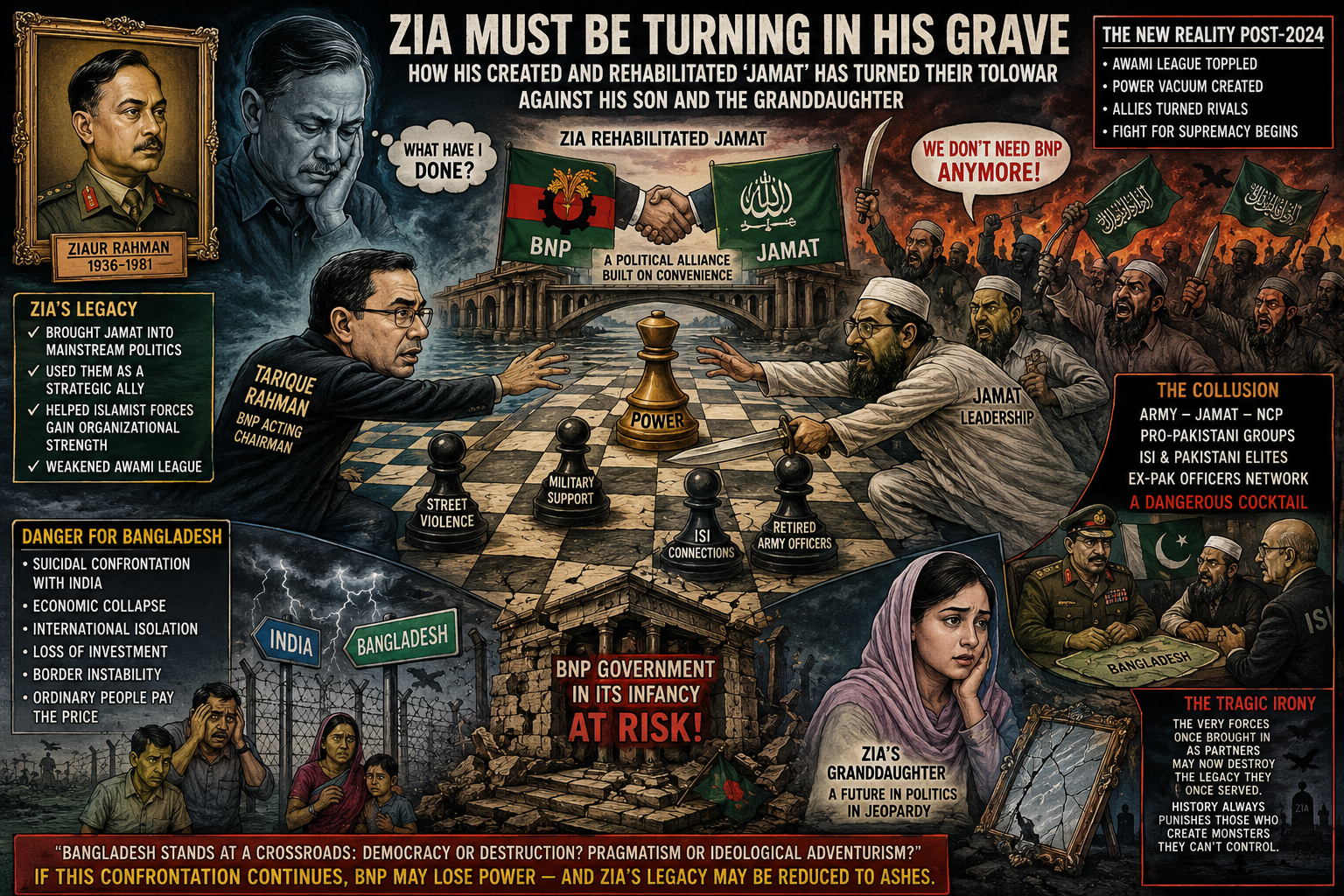
Yet history possesses a cruel habit of devouring its own architects.
Today, the very Islamist constituency that benefited from political rehabilitation appears increasingly unwilling to remain a junior partner. The post-2024 political order has emboldened forces that now see themselves not as auxiliaries of the BNP, but as contenders for power in their own right.
The emerging tension between the BNP and Jamaat is no longer a matter of speculation. Analysts increasingly identify the rivalry as one of the defining fault lines of Bangladesh’s new political landscape. Multiple observers note that both camps are competing for leadership of the post-Hasina era and that this competition carries significant risks of instability and confrontation.
The irony is striking.
For years, Jamaat needed the BNP. Now, significant sections within Jamaat appear to believe that the BNP needs them more. That shift in political psychology changes everything.
The removal of the Awami League from the centre of political competition has created a vacuum. Instead of producing stability, it has intensified the struggle among former allies. Political analysts have repeatedly warned that post-2024 Bangladesh is witnessing the fragmentation of anti-Awami forces into competing centres of influence involving the BNP, Jamaat, student-led formations, and various nationalist factions.
The danger for the BNP is that it may have inherited power without fully controlling the forces that helped create the conditions for that power. History offers numerous examples where revolutionary coalitions collapse once the common enemy disappears.
Bangladesh increasingly resembles such a case.
The rise of the student-led NCP, the assertiveness of Islamist organisations, the activism of retired military officers, and growing political violence suggest that the anti-Awami coalition has entered a phase of internal competition. Reports have highlighted escalating tensions among BNP, Jamaat, and NCP actors, including disputes over political direction, elections, and state institutions. For Tarique Rahman, this presents an uncomfortable reality.
The BNP’s challenge is no longer merely governing.
It is surviving. The party now faces pressure from several directions simultaneously: economic expectations, governance failures, factionalism, growing street-level violence, and competition from Islamist and populist forces eager to occupy political space. Analysts have noted that the BNP government faces major governance and economic tests as it attempts to consolidate authority after the transition period.
What makes the situation even more delicate is the perception among many observers that sections of Bangladesh’s political class continue to operate within older geopolitical instincts.
Pakistan remains a symbolic reference point for some political actors. India remains the defining strategic concern for others. And Bangladesh itself frequently becomes the arena upon which these competing visions collide.
There is growing public debate over whether parts of the country’s Islamist-nationalist ecosystem are attempting to push Bangladesh into an unnecessarily confrontational posture towards India at a time when economic realities demand pragmatism. Relations between Dhaka and New Delhi have already experienced visible strains over migration, border management, and political developments following the 2024 upheaval.
The danger is not merely diplomatic. It is structural.
Bangladesh’s economy remains deeply interconnected with regional stability. Any prolonged deterioration in relations with India would affect trade, connectivity, border management, security cooperation, energy arrangements, and investment confidence. The rhetoric of confrontation often sounds attractive at political rallies. The consequences are usually paid for by ordinary citizens.
One of the most remarkable developments since 2024 has been the growing prominence of ideological narratives many believed had been relegated to the margins. The ban and political exclusion of the Awami League altered the equilibrium of Bangladeshi politics and created space for new alignments. Observers have noted that former Awami League voters have dispersed across competing opposition forces, including both BNP and Jamaat, thereby reshaping electoral calculations.
This has produced an unintended consequence. The BNP’s traditional anti-Awami platform is losing its utility. If the Awami League is no longer the principal competitor, the BNP must now define itself against forces that were once allies.
That is a far more difficult political task.
Moreover, political violence remains deeply embedded within the transition period. Reports from rights groups and international observers describe persistent clashes, killings, intimidation, and election-related violence involving multiple political actors. Some analyses have warned that rivalry between BNP and Jamaat could escalate into direct confrontation as both seek dominance in the new order.
This is where the shadow of Ziaur Rahman returns.
Zia built the BNP around nationalism, state authority, and a broad coalition capable of counterbalancing the Awami League.
Yet the coalition he helped create was always internally contradictory.
Nationalists.
Islamists.
Military-linked networks.
Conservative elites.
Business interests.
Regional power brokers.
These forces could coexist while confronting a common opponent. Whether they can coexist while competing for power is a different question altogether.
Some political observers increasingly argue that the BNP now risks becoming trapped between competing pressures. On one side stand voters seeking stability, investment, governance, and economic recovery. On the other stand ideological actors demanding deeper structural transformations, more confrontational regional policies, and a redefinition of Bangladesh’s national identity. Balancing those competing demands may prove impossible.
The most alarming possibility is not that the BNP loses popularity.
It is that the state itself becomes paralysed by continuous political confrontation. Bangladesh has already spent decades trapped within cycles of revenge politics, military intervention, ideological polarisation, and institutional weakness. Many citizens hoped that the post-2024 transition would break that pattern. Instead, there are growing signs that the country may simply be entering another version of the same cycle.
Security analysts continue to highlight concerns regarding polarisation, factional disputes, violent mobilisation, and weakened institutional trust. Several assessments warn that Bangladesh remains vulnerable to prolonged instability if political actors fail to establish a consensus-based framework for competition.
For Tarique Rahman, the stakes are intensely personal.
This is not merely about a government. It is about a political inheritance. It is about whether the Zia family remains the central pillar of Bangladeshi nationalism or becomes another casualty of the forces it once nurtured.
Political dynasties survive not because of history but because they retain relevance.
The danger for the BNP leadership is that younger Islamist, populist, and nationalist actors increasingly believe that the future belongs to them rather than to established political families. The rise of competing political formations after 2024 demonstrates precisely that dynamic.
And what of the next generation?
If political fragmentation continues, the long-term prospects of future Zia family leadership may become increasingly uncertain. Political legacies are not inherited automatically. They must be defended, renewed, and adapted to changing realities.
History is filled with the descendants of powerful leaders who discovered that their surnames no longer guaranteed political authority. Bangladesh is not immune to that phenomenon. The tragedy would be particularly striking given the origins of the relationship itself. The very forces once brought into the mainstream as partners could emerge as rivals. The very networks once viewed as strategic assets could become strategic liabilities. The very political architecture designed to weaken one adversary could eventually undermine its own creators. Whether that outcome materialises remains uncertain. But the warning signs are difficult to ignore.
Bangladesh today stands at a crossroads between democratic consolidation and renewed confrontation. Between statecraft and ideological adventurism. Between pragmatic diplomacy and emotional geopolitics. Between institutional politics and perpetual mobilisation.
If the country’s political leadership fails to recognise those dangers, the consequences may extend far beyond the fortunes of any single party. And if that happens, many Bangladeshis may well conclude that the greatest threat to the BNP did not come from its historic opponents. It came from the contradictions embedded within its own political legacy.
In that sense, the question remains hauntingly relevant:
If Ziaur Rahman could witness the present moment, would he recognise the forces battling under the banners he helped shape — or would he see a movement consuming itself, one faction at a time?