A Nation at a Crossroads of Memory, Identity and Geopolitics
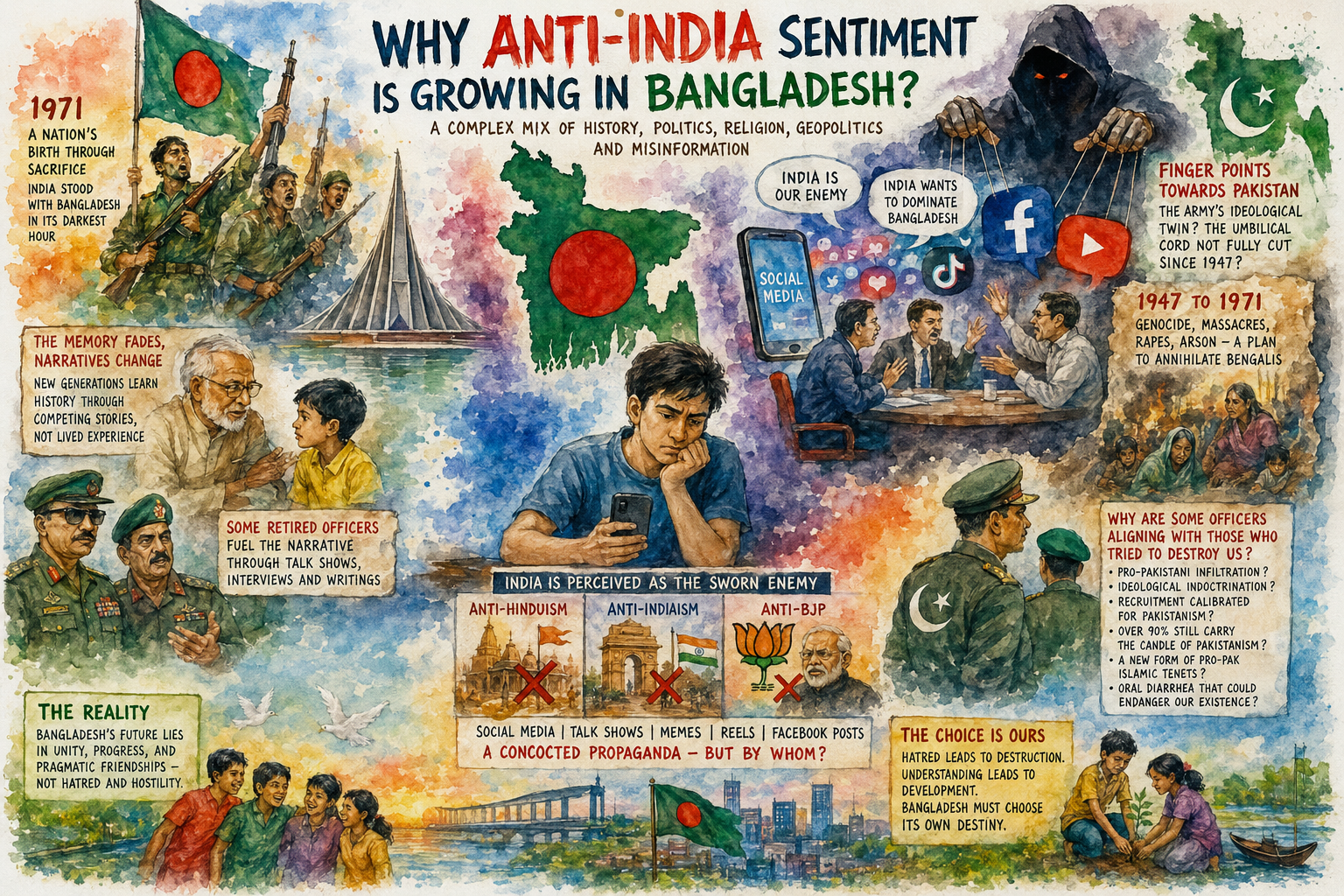
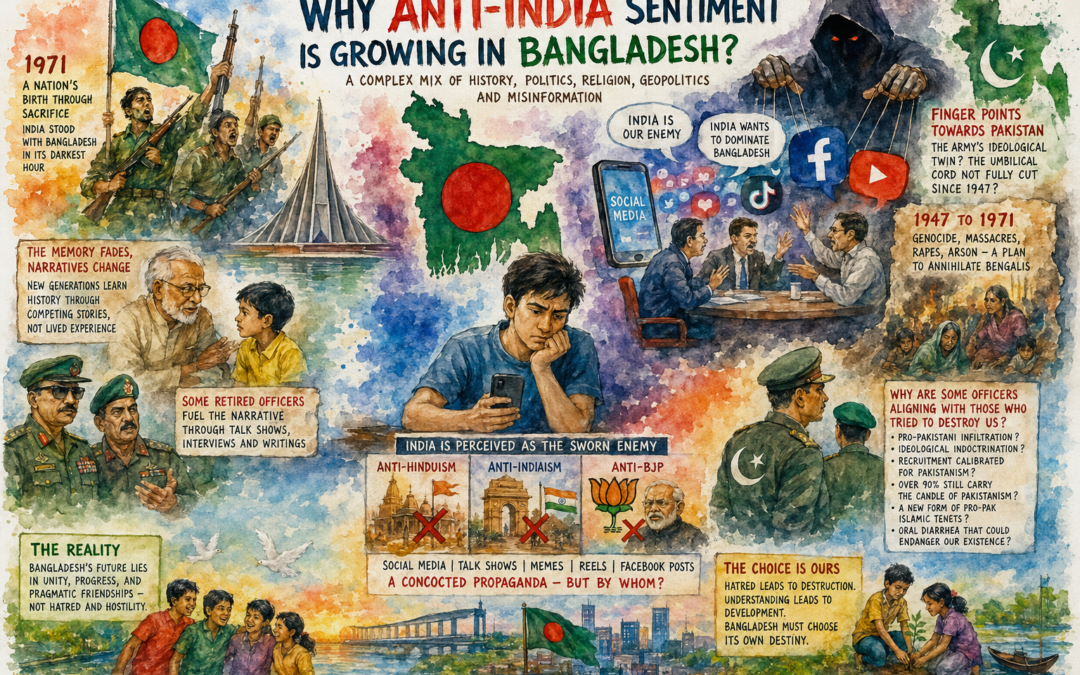
Over the past several years, particularly since the political upheavals of 2024, Bangladesh has witnessed a noticeable rise in anti-India rhetoric across social media, television talk shows, YouTube channels, Facebook pages, political gatherings, and diaspora discussions.
What is perhaps more surprising to many observers is that some of the loudest voices are not anonymous online activists but retired military officers, former bureaucrats, political commentators, and self-described nationalist intellectuals.
The question is simple but important:
Why has anti-India sentiment become so prominent in certain circles of Bangladeshi public life?
More importantly, what explains this phenomenon in a country whose independence in 1971 was secured with enormous assistance from India and whose people found refuge across the border during one of the darkest chapters in South Asian history?
The answer is neither simple nor singular.
It lies at the intersection of history, politics, religion, nationalism, identity, misinformation, geopolitical competition, and generational change.
The 1971 Generation Is Fading
One of the most important factors is demographic.
The generation that directly witnessed the Bangladesh Liberation War is gradually passing away.
Those who saw the genocide, crossed into India as refugees, fought alongside the Mukti Bahini, or witnessed Indian military intervention in December 1971 possessed lived memories.
For them, India was not an abstract geopolitical actor.
It was a tangible reality.
As those memories fade, newer generations increasingly encounter 1971 through competing political narratives rather than personal experience.
Historical memory becomes vulnerable when it is no longer protected by living witnesses.
Nationalism Requires an External Reference Point
Many nations define themselves partly through comparison with neighbouring states.
In Bangladesh, political parties have often used India as either a strategic partner or a political foil.
Some political actors portray India as Bangladesh’s closest friend.
Others depict India as an overbearing regional power.
Both narratives simplify a far more complicated reality.
The danger arises when criticism of Indian policy evolves into hostility towards India itself.
A distinction must always be maintained between legitimate policy disagreements and blanket hostility towards an entire nation.
Social Media Has Amplified Grievances
The explosion of Facebook, YouTube, TikTok, and other digital platforms has transformed political discourse.
Algorithms reward outrage.
Nuance rarely goes viral.
A carefully researched article may receive a few hundred views.
A provocative anti-India meme may reach millions.
This creates an incentive structure that rewards sensationalism.
Claims that once remained on the margins are now continuously amplified through social networks.
The result is a feedback loop in which users repeatedly encounter similar content and begin to perceive it as established truth.
Religious Identity Is Becoming More Prominent
Another factor is the increasing prominence of religious identity within political discourse.
Bangladesh was founded on principles that included Bengali nationalism and secularism.
However, over the decades, political competition has increasingly incorporated religious symbolism and Islamic identity.
In such an environment, developments in India involving Hindu nationalism, communal tensions, or controversial statements by political figures often generate strong reactions.
Many Bangladeshis distinguish between India as a state and Hindu nationalism as an ideology.
Others do not make that distinction.
Consequently, criticism of specific political developments in India can sometimes evolve into broader anti-India sentiment.
Geopolitical Competition Is Intensifying
Bangladesh occupies one of the most strategically important locations in Asia.
It sits between South Asia and Southeast Asia and borders India on three sides.
As global competition intensifies among major powers, Bangladesh is increasingly being courted by multiple actors.
China seeks influence through infrastructure.
Western powers focus on democracy and governance.
India prioritises security and regional stability.
Pakistan seeks to rebuild diplomatic and economic ties.
In such an environment, competing narratives inevitably emerge.
Every major power seeks to shape perceptions.
Bangladeshis are therefore exposed to multiple and often contradictory geopolitical messages.
The Legacy of Pakistan Remains Complicated
A difficult and sensitive question concerns attitudes towards Pakistan.
Despite the atrocities committed during 1971, some segments of Bangladeshi society have gradually adopted a more favourable view of Pakistan.
Several factors explain this.
First, younger generations did not experience 1971 directly.
Second, religious affinity sometimes overrides historical memory.
Third, social media content frequently presents romanticised narratives of Muslim unity.
Fourth, frustration with domestic politics often encourages people to idealise foreign alternatives.
None of this erases history.
But it helps explain why some individuals may view Pakistan differently from earlier generations.
Retired Military Officers and Public Commentary
Retired military officers often command public attention because they are perceived as disciplined, knowledgeable, and patriotic.
However, retired officers are not a homogeneous group.
They hold diverse political views.
Some are strongly pro-India.
Others are highly critical of India.
Some advocate balanced diplomacy.
Others favour more confrontational positions.
The public should therefore avoid assuming that a handful of vocal commentators represent the views of an entire institution.
Military institutions are generally more diverse than political debates suggest.
Conspiracy Thinking Is Increasing
One worrying trend is the growing popularity of conspiracy theories.
Complex political developments are increasingly explained through claims of secret plots, hidden networks, foreign manipulation, or invisible enemies.
Such narratives are emotionally satisfying because they provide simple explanations for complicated problems.
Yet they often distract attention from genuine domestic challenges such as corruption, governance failures, economic inequality, and institutional weakness.
Nations rarely decline because of external conspiracies alone.
They decline when internal weaknesses remain unaddressed.
Anti-India Sentiment Does Not Solve Bangladesh’s Problems
Perhaps the most important question is practical.
Even if one strongly criticises India, what does that achieve?
Will anti-India rhetoric reduce inflation?
Will it create jobs?
Will it improve education?
Will it strengthen institutions?
Will it increase foreign investment?
The answer is usually no.
National development depends upon competent governance, economic growth, innovation, education, and social cohesion.
Hostility alone cannot produce prosperity.
The Real Challenge
Bangladesh today faces a historic choice.
It can become trapped within cycles of emotional nationalism, historical revisionism, and geopolitical hostility.
Or it can pursue a confident, self-assured national identity that engages with neighbours pragmatically while protecting its own interests.
Strong nations do not require permanent enemies.
They require clear strategic thinking.
Bangladesh’s future will not be secured by hatred towards India, Pakistan, China, or any other country.
It will be secured by strengthening Bangladesh itself.
The ultimate lesson of 1971 was not perpetual hostility.
It was the determination of a people to control their own destiny.
That remains as relevant today as it was more than half a century ago.