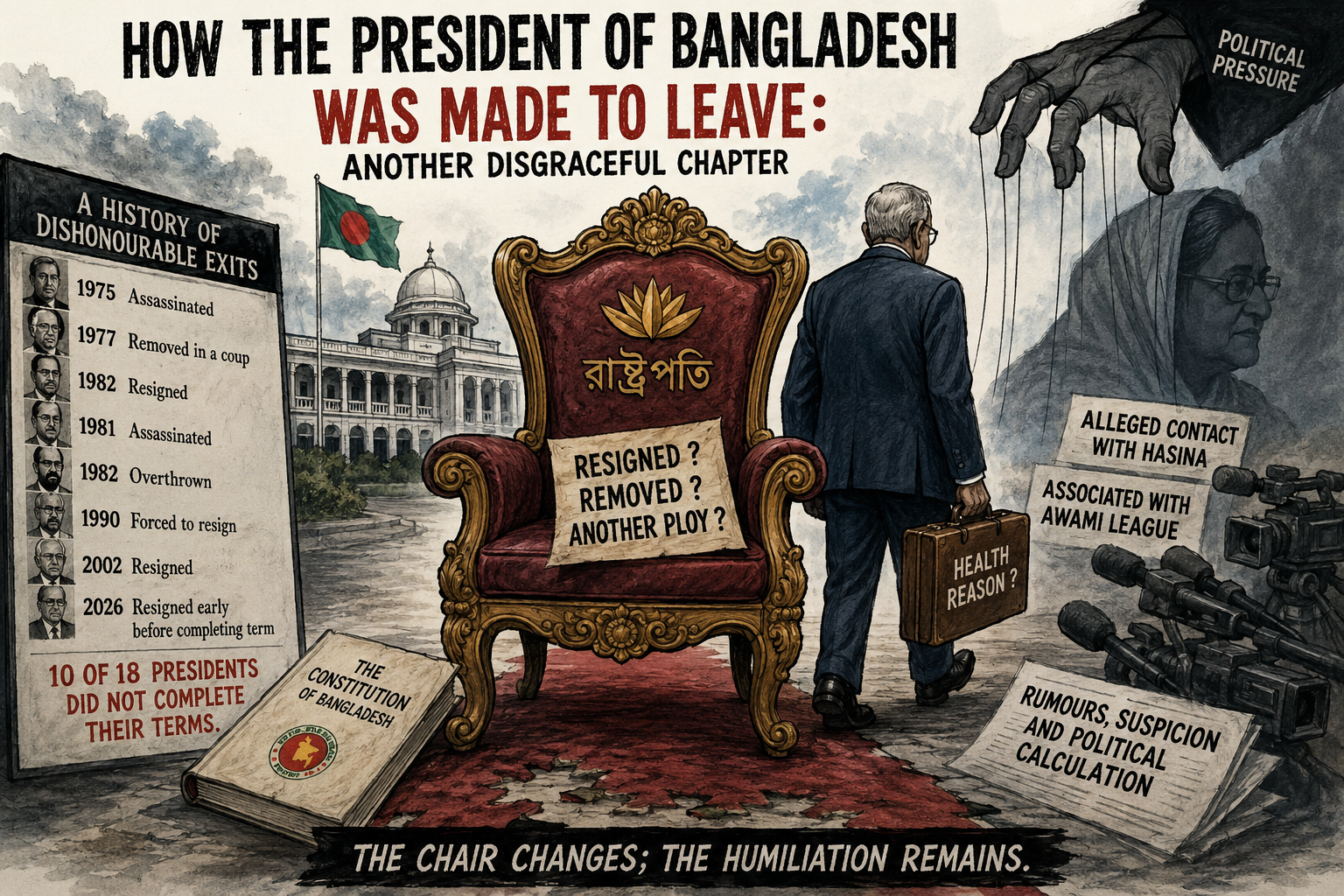
Bangladesh has once again witnessed an occupant of Bangabhaban leave office not through a dignified constitutional transition, but amid rumours, pressure, suspicion and political calculation. President Mohammed Shahabuddin resigned on 24 July 2026, almost two years before his term was due to end. His letter cited serious health complications and an inability to continue discharging his responsibilities. Yet reports surrounding his departure pointed to mounting political pressure, his association with the former Awami League government and controversy over alleged contact with Sheikh Hasina. The contrast between the official explanation and the political circumstances inevitably raises the question: was this truly a voluntary resignation, or another carefully arranged removal disguised as constitutional normality? (The Business Standard)
The episode is disgraceful not merely because one president has resigned early. It is disgraceful because Bangladesh’s highest constitutional office has repeatedly been treated as a disposable instrument of whoever controls the political moment. The presidency is ceremonially exalted yet politically vulnerable—revered in speeches, manipulated in practice and discarded whenever its occupant becomes inconvenient.
The historical record is grim. Sheikh Mujibur Rahman was assassinated in office in 1975. Khondaker Mostaq Ahmad was removed in a coup. Justice Abu Sadat Mohammad Sayem resigned as military power consolidated elsewhere. Ziaur Rahman was assassinated in 1981. Justice Abdus Sattar was overthrown by General Ershad, who was himself forced to resign following a mass uprising in 1990. A.Q.M. Badruddoza Chowdhury resigned in 2002 after losing the confidence of the party that had elevated him. Now Mohammed Shahabuddin has departed before completing his term. A recent historical review concluded that 10 of Bangladesh’s 18 presidents failed to complete their terms. (The Daily Star)
It would be inaccurate to claim that literally every president left dishonourably. Abdur Rahman Biswas, Shahabuddin Ahmed, Iajuddin Ahmed and Abdul Hamid completed their constitutional tenures. But even some apparently orderly presidencies were surrounded by confrontation, partisan controversy or institutional weakness. The larger truth therefore remains: Bangladesh has rarely allowed the presidency to mature into an independent, respected and stabilising constitutional institution.
The Constitution permits a president to resign by writing to the Speaker. That procedure may have been followed. (Bangladesh Laws) But constitutional paperwork alone cannot transform a politically pressured exit into an honourable farewell. Shahabuddin’s official reason was illness, while international reporting also described intense pressure linked to his political associations and the changing balance of power. (AP News)
This is the deeper national shame. Presidents are chosen as loyalists, retained as ornaments and removed as liabilities. Bangabhaban has become less a guardian of constitutional continuity than a gilded waiting room for political obedience.
If this resignation was genuinely voluntary, the government should disclose the process transparently and permit a dignified transition. If it was politically engineered, then Bangladesh has merely repeated an old and poisonous habit: changing the occupant without reforming the institution.
The chair changes; the humiliation remains.