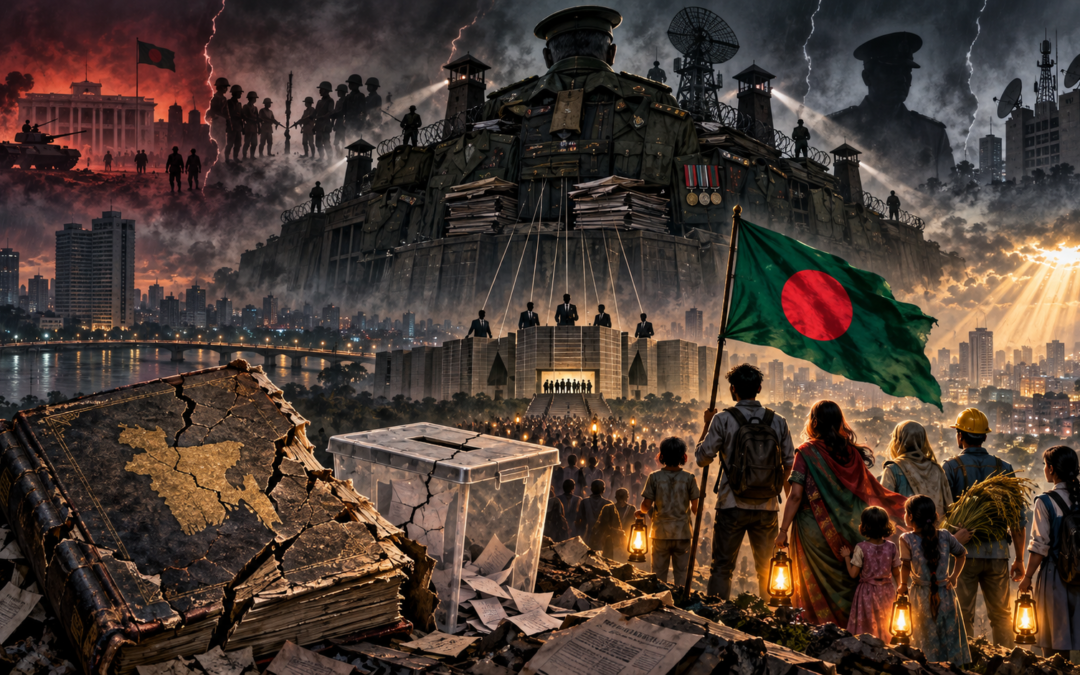
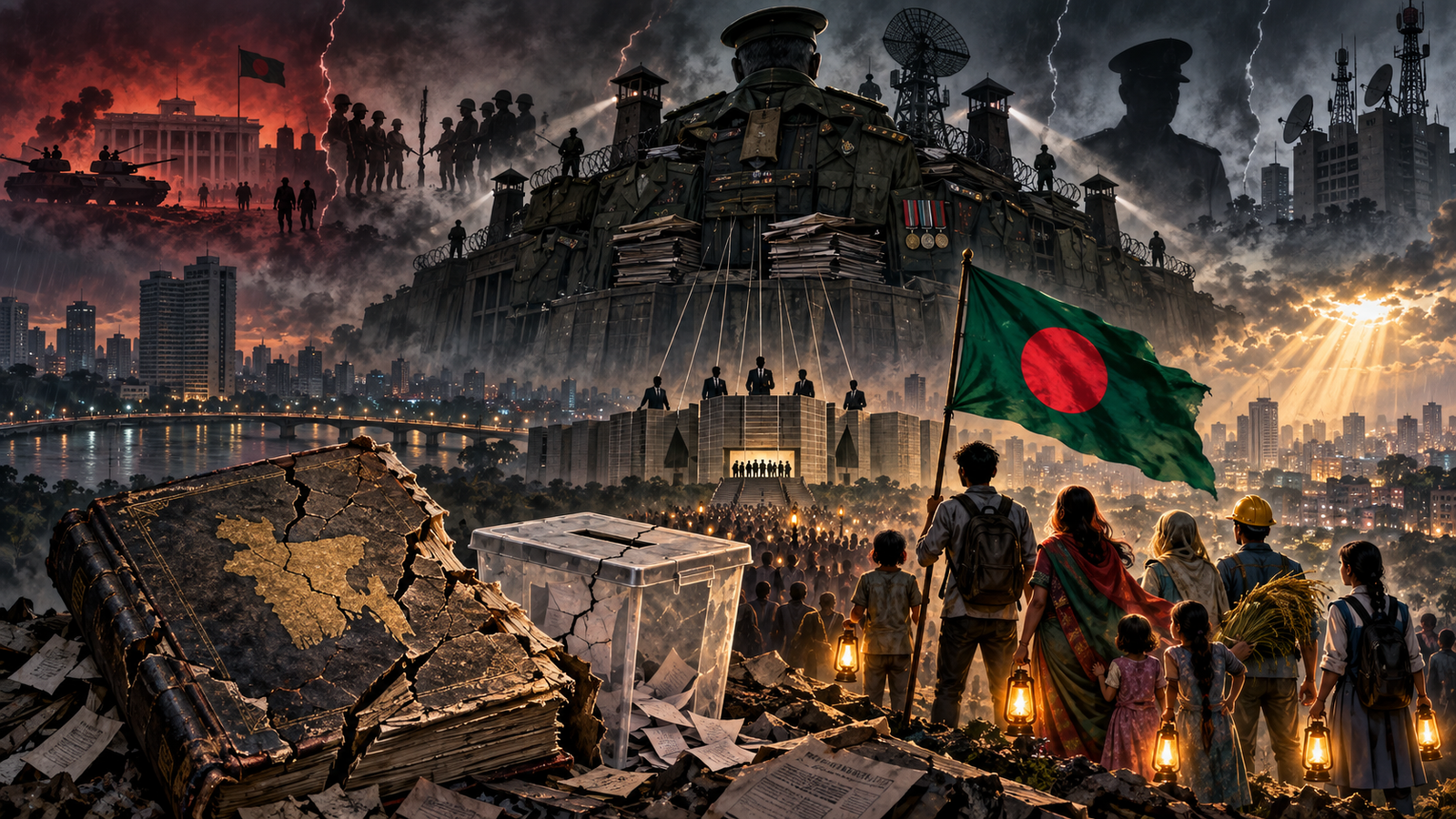
Bangladesh was born through a people’s struggle for freedom. Yet, almost immediately after independence, the country inherited a military establishment whose professional culture had been shaped inside the Pakistani state.
The men who returned from Pakistan were not all traitors. Many had been imprisoned, interned or held as bargaining instruments after 1971. They had families, careers and a legitimate right to return home. Bangladesh needed trained officers, and the new state could not build an army from nothing.
But the decision to absorb them created a contradiction at the heart of the Republic.
Bangladesh had been created through a mass national struggle against military domination. Yet the new country placed a significant part of its military future in the hands of men whose formative careers had developed within a political system where the armed forces had repeatedly acted as the final authority of the state.
The question is not whether every repatriated officer was disloyal.
The question is whether the institution they helped shape ever truly accepted that the army was subordinate to the civilian government.
The psychology of the uniform
The most damaging legacy was psychological.
The army was no longer simply an institution that defended the country. It began to imagine itself as the institution that understood the country better than politicians, civil servants or ordinary citizens.
The uniform became a certificate of superior patriotism.
The officer became more than a public servant. He became, in the institutional imagination, a guardian of the nation’s morality, security and destiny.
This is where service can quietly turn into ownership.
The argument becomes:
“We fought for the country; therefore, we understand the country.”
Then:
“Politicians are corrupt; therefore, we must correct them.”
Then:
“Civilian government is weak; therefore, we must supervise it.”
Finally:
“The country belongs to those who are capable of saving it.”
That is the intellectual route by which a professional military can become a political class.
From Farooq and Rashid to the destruction of constitutional authority
The August 1975 coup was the clearest and most brutal expression of this mentality.
Farooq Rahman and Khandaker Abdur Rashid, together with other officers, helped overthrow the constitutional order and assassinate Sheikh Mujibur Rahman and members of his family.
Whatever grievances existed against Mujib’s government, no officer had the constitutional right to replace political disagreement with assassination.
The coup established a terrifying principle: that a group of armed officers could decide that the elected political order had forfeited its right to exist.
Once that principle was introduced, Bangladesh’s constitutional life was permanently damaged.
The army no longer appeared merely as a defender of the state. It had demonstrated that it could become the state.
Khaled Mosharraf and the tragedy of competing military legitimacy
Khaled Mosharraf must be treated differently from Farooq and Rashid.
He was a Liberation War commander and a respected military officer who attempted to remove the officers associated with the August killings. His intervention was not identical in purpose to the coup that assassinated Mujib.
But the tragedy is that even an attempt to restore order took the form of another military seizure of political authority.
This revealed the deeper disease: different military factions were claiming different versions of national legitimacy.
One faction claimed to have saved Bangladesh from political decay.
Another claimed to be defending the spirit of the Liberation War.
A third claimed to represent the soldiers and the revolutionary masses.
The civilian constitutional order was pushed aside while armed factions argued over which version of patriotism should govern the country.
Taher and the revolution from below
Colonel Abu Taher represented another dangerous possibility: the politicisation of the ranks.
His vision was not simply a conventional military dictatorship. It was a revolutionary transformation in which soldiers and ordinary people would challenge the officer class and restructure the state.
The November 1975 uprising demonstrated that the army was no longer united behind a single chain of command. Soldiers could be mobilised against officers, officers could be killed by their own men, and competing political movements could enter the cantonment.
The result was not liberation from military politics. It was the complete breakdown of military professionalism.
When soldiers are taught that political revolution is part of their duty, the distinction between the barracks and the street disappears.
Zia and the institutionalisation of military power
Ziaur Rahman emerged from the chaos of November 1975 and gradually consolidated authority. The immediate political disorder gave him an opportunity to present military power as the only force capable of restoring stability.
This is how military rule often becomes legitimate in the eyes of a frightened population.
The argument is not:
“I want power.”
It is:
“Someone must save the country.”
Zia’s period demonstrated how military authority could be converted into political authority, and then into an organised political party.
The uniform did not remain outside politics. It became the foundation from which political power was constructed.
Ershad and the normalisation of military government
General Hussain Muhammad Ershad’s 1982 coup took the process further.
By then, Bangladesh had already experienced assassinations, counter-coups, military killings and constitutional uncertainty. Ershad could therefore present military rule as something almost normal: another intervention in a country where civilian politicians had failed to establish institutional stability.
His regime demonstrated the full transformation of the military establishment into a political machine.
The army was no longer merely governing temporarily. It had become a system of appointments, patronage, business interests, political mobilisation and controlled legitimacy.
The people were told that military government was necessary because politicians were corrupt and disorderly.
But after years of military rule, Bangladesh did not become free from corruption or disorder. It became accustomed to the idea that the army could stand above the political process.
Moeen and the return of military guardianship
In 2007, General Moeen U Ahmed became associated with another military-backed political intervention. The army did not formally install a general as president, but it supported the caretaker administration that replaced the existing political arrangement and governed under a state of emergency. International Crisis Group
That episode revealed that the military did not need to seize the presidency directly to dominate the political environment.
It could rule from behind the constitutional curtain.
It could allow civilians to occupy government offices while retaining decisive influence over the limits of political activity, the detention of leaders, the conduct of elections and the operation of intelligence agencies.
This was military power without the visible burden of military uniforms in government buildings.
And now?
Now the legacy has no single face.
It appears whenever serving officers begin to believe that their profession gives them a superior claim to national decision-making.
It appears when retired officers act as political brokers.
It appears when political parties cultivate military networks rather than strengthening Parliament.
It appears when intelligence agencies become instruments of political control.
It appears when citizens say that the army is more honest, more disciplined and more capable than elected politicians.
It appears when the armed forces are treated as the owner of the country rather than its servant.
The danger is not that every officer wants a coup. There is no evidence to justify such a sweeping claim.
The danger is that the institutional temptation remains.
A military that has intervened repeatedly may begin to believe that intervention is part of its historical mission.
The country may change governments, constitutions and political parties, but the underlying assumption survives:
“If civilian leaders fail, the army must decide.”
That assumption is the real inheritance.
The lie of permanent guardianship
The most enduring justification of military intervention is the claim that the armed forces protected independence.
That claim may contain elements of truth. Many military personnel contributed to the Liberation War. Others protected Bangladesh during later conflicts and national emergencies.
But protecting independence does not create a permanent licence to rule.
The people of Bangladesh did not win independence so that one institution could inherit the state as private property.
The army belongs to the Republic. The Republic does not belong to the army.
Any officer who confuses personal honour with political entitlement has already crossed the line between patriotism and authoritarianism.
The people paid the price
The ordinary people paid for every military intervention.
They paid through:
- suspended constitutions;
- assassinations;
- secret detentions;
- political disappearances;
- censorship;
- fear of intelligence agencies;
- cancelled elections;
- corruption protected by power;
- economic uncertainty;
- political revenge;
- the destruction of trust in public institutions.
The military repeatedly claimed that it was rescuing Bangladesh from civilian failure. Yet each intervention weakened the civilian institutions that might eventually have learned to govern effectively.
This created a permanent cycle:
- civilian politicians weaken institutions;
- the military intervenes;
- military rule weakens democratic accountability;
- civilian politics returns in a damaged condition;
- politicians again use state institutions for partisan purposes;
- the military presents itself as the only national institution capable of restoring order.
Bangladesh has been trapped inside this cycle for decades.
The indictment
The indictment is not that every repatriated officer was a traitor.
The indictment is that the state failed to separate military service from political ownership.
It failed to create a transparent settlement between repatriated personnel, freedom fighters and civilian authority.
It failed to teach the armed forces that sacrifice does not confer sovereignty.
It failed to establish that the army’s loyalty must be to the Constitution, not to a commander, faction, ideology, intelligence agency or political patron.
The tragedy of Bangladesh is that men who claimed to protect the country repeatedly treated the country as something to be possessed.
They spoke in the language of national duty while acting through the mechanisms of institutional power.
They claimed to defend the people while denying the people the right to govern themselves.
That is the scathing truth of the legacy:
The army was built to defend Bangladesh, but successive generations were encouraged to believe that Bangladesh needed to be governed by the army.
And until that belief is destroyed, the country will remain vulnerable to the same old temptation—the temptation of the uniform to mistake service for ownership.
To this day, a powerful current within the Bangladesh Army continues to believe that it saved the country by governing it.