Bangladesh appears to be approaching a dangerous strategic crossroads. Reports that Dhaka is considering joining the so-called Mecca Joint Defence Pact—a collective-security arrangement involving Pakistan, Saudi Arabia and Türkiye—have generated questions that are not merely numerous; they are staggering.
The pact has been presented as defensive, with an attack upon one member supposedly treated as an attack upon all. Yet Bangladesh must ask what this promise would mean in practice, whose wars it might inherit, and whether any credible national interest justifies abandoning its tradition of non-alignment. Dhaka has reportedly viewed possible membership positively, although no final decision has been announced. Reuters
This is already being promoted in some quarters as an Islamic counterpart to NATO. That description is more political theatre than strategic reality. NATO rests upon decades of institutional integration, shared command structures, interoperability, intelligence systems, logistical capacity and clearly defined treaty mechanisms. The Mecca Pact possesses none of that maturity. It is, at present, an ambitious declaration whose military obligations, command arrangements, financial responsibilities and exit provisions remain dangerously unclear.
For Bangladesh, joining such an experiment would not demonstrate strategic independence. It could amount to purchasing an unspecified liability with the country’s sovereignty.
A Government Searching for an Ideological Anchor
The deeper concern is the character of Bangladesh’s emerging neo-pseudo-radical governance: a political order seeking legitimacy through religious symbolism, selective nationalism and manufactured hostility towards particular countries, communities and historical truths.
Religion is being drawn into foreign policy as an instrument of political alignment. Minority anxieties are increasing, secular traditions are being treated with suspicion, and anti-India rhetoric is being cultivated as though antagonism itself were a national strategy.
This is not strategic depth. It is ideological shallowness dressed in ceremonial language.
Bangladesh was founded upon Bengali nationalism, linguistic identity, representative government and resistance to military domination. It was not created to become a satellite of a distant religious-security bloc. To reduce the country’s foreign policy to a slogan of confessional solidarity would betray both the complexity of Bangladesh and the pluralistic promise of its liberation.
A sovereign state must have friends, partners and defence relationships. But those relationships must be built upon geography, trade, security, history and demonstrable national interest—not emotion, historical amnesia or a government’s need for ideological applause.
Can 1971 Simply Be Erased?
Most disturbing is the proposed military embrace of Pakistan without a full and honest reckoning with 1971.
This is the same Pakistani military establishment whose forces unleashed Operation Searchlight, used tanks and artillery in densely populated areas, attacked students and civilians, burned settlements, destroyed infrastructure and committed mass atrocities across what was then East Pakistan.
Men, women, children, labourers, passengers, intellectuals and villagers were consumed by a campaign intended to crush Bengali political aspirations through terror. Town after town witnessed arson and devastation. Families were displaced, women suffered organised sexual violence, and millions crossed into India as refugees.
On 16 December 1971, Pakistan’s Eastern Command surrendered in Dhaka. Approximately 93,000 Pakistani military personnel and associated civilians subsequently entered Indian custody. That surrender did not erase the dead, rebuild the ruined homes or answer the historical demand for accountability.
Bangladesh may maintain diplomatic relations with Pakistan. Reconciliation between states is sometimes necessary. But reconciliation without truth, acknowledgement, apology or justice is not reconciliation—it is organised forgetting.
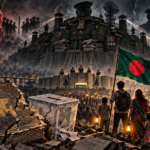
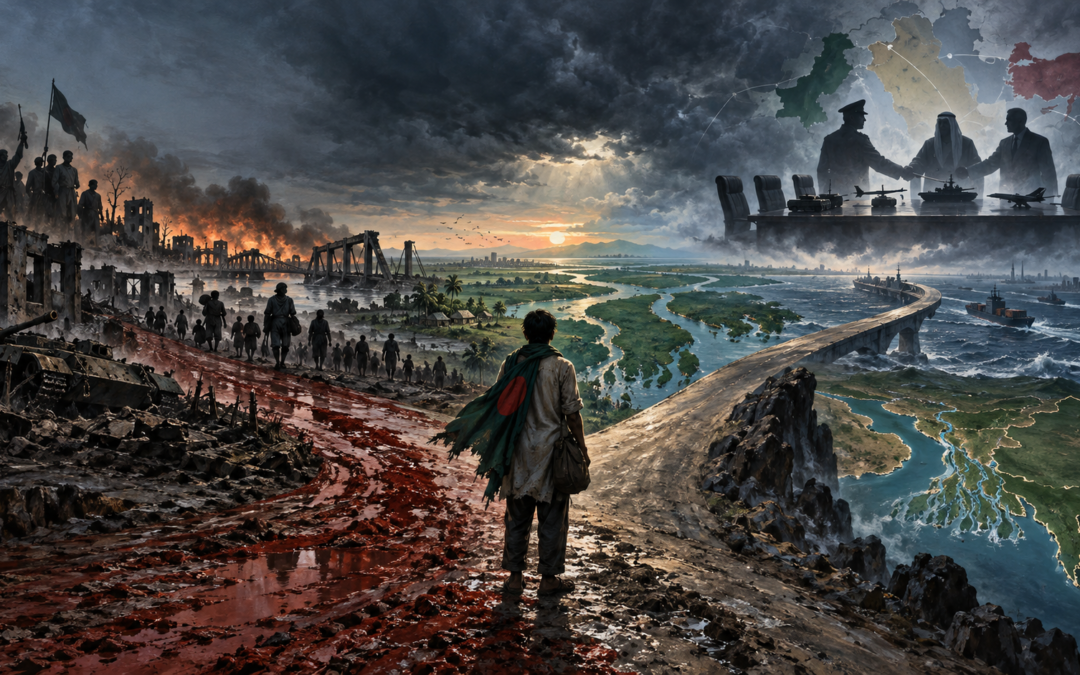
Now Bangladesh is contemplating a defence arrangement in which Pakistan could become a central military node. Are the memories of 1971 to be discarded because today’s rulers find a new alliance politically convenient? Is the blood-soaked landscape of liberation merely an obstacle to be walked over on the way to a new ideological partnership?
The people deserve an answer.
Whose Wars Would Bangladesh Be Joining?
Pakistan has experienced repeated wars, military confrontations, border crises, covert operations and periods of intense hostility with India. It also faces internal militancy, tension along its western frontier and complicated relations with several regional actors.
If Pakistan became involved in another confrontation, would Bangladesh be legally or politically obliged to provide troops, intelligence, logistical support, naval access or diplomatic cover?
Would Bangladeshi soldiers be expected to participate in a conflict arising from decisions over which Dhaka had no control?
Would Bangladesh be drawn into Middle Eastern confrontations involving Iran, Yemen or other regional powers? Would it be required to defend Saudi territory or infrastructure? Could it be expected to support Türkiye in a crisis arising far beyond South Asia?
Conversely, if Bangladesh faced a genuine national emergency, would distant partners actually come to its rescue?
Saudi Arabia and Türkiye are separated from Bangladesh by thousands of miles. Neither shares its borders, river systems, maritime environment or immediate security realities. Their willingness to issue statements of solidarity should not be confused with the ability—or political readiness—to sustain Bangladesh during a major regional conflict.
Diplomatic promises travel quickly. Divisions, aircraft, ships, ammunition and logistical supply lines do not.
Is India the Unspoken Target?
The most troubling possibility is that Bangladesh is being invited—or quietly encouraged—to join this alliance as part of Pakistan’s enduring strategic obsession with India.
If that is the hidden purpose, Bangladesh must refuse.
Bangladesh is surrounded by India on three sides. The two countries share a border exceeding 4,000 kilometres, numerous rivers, transport corridors, energy connections, extensive trade, intertwined communities and a common Bay of Bengal neighbourhood.
Dhaka has legitimate disagreements with New Delhi. Water sharing, border conduct, trade imbalances, political interference and the treatment of minorities must all be discussed firmly. Friendship does not require submission, and geography does not eliminate Bangladesh’s right to independent policy.
But disagreement is not a justification for strategic self-harm.
Joining a Pakistan-centred security arrangement that India could reasonably interpret as hostile would expose Bangladesh to enormous risks. Trade, energy cooperation, border management, transit and regional connectivity could all be affected. It could also turn Bangladesh into a theatre for intelligence competition, proxy politics and military pressure.
Would Saudi Arabia or Türkiye compensate Bangladesh for disrupted trade? Would they replace vital transport links? Would they manage an unstable land frontier stretching for thousands of kilometres? Would they protect Bangladeshi ports or supply the country during a blockade?
Geography cannot be defeated by slogans.
A Pact Without Public Consent
Before Bangladesh accepts even preliminary commitments, the government must publish the proposed treaty and place it before Parliament and the public.
The country deserves clear answers:
- What constitutes an “attack” under the pact?
- Who decides when collective defence obligations are activated?
- Would Bangladesh be required to send troops abroad?
- Could foreign forces, advisers or intelligence facilities be stationed in Bangladesh?
- Would membership create financial or arms-purchasing obligations?
- Is nuclear protection being implied?
- Could Bangladesh refuse participation in a war it considered unjust?
- What is the mechanism for withdrawal?
- Has an assessment been made of the consequences for relations with India, China, Iran, the United States and other partners?
- Has the military provided advice independently, or is ideology driving the decision?
Without transparent answers, membership would be a reckless leap into strategic darkness.
Bangladesh Must Not Become Someone Else’s Battlefield
Bangladesh requires a balanced foreign policy: friendship with India without dependence, engagement with China without entrapment, relations with Pakistan without historical amnesia, and cooperation with the Muslim world without surrendering its sovereignty or pluralistic character.
Its armed forces should defend Bangladesh—not serve as an expeditionary instrument for distant monarchies, ideological blocs or another country’s geopolitical rivalries.
The country’s priorities are economic resilience, climate security, maritime resources, border stability, technological development, food security and the protection of every citizen regardless of religion. None of these objectives will be advanced by joining a vaguely defined alliance carrying the possibility of inherited wars.
The proposed Mecca Pact may be wrapped in the language of religious solidarity and collective defence. Beneath that wrapping, however, lies a profound danger: Bangladesh could exchange its hard-won strategic freedom for obligations written elsewhere, triggered by others and paid for by Bangladeshi lives.
In 1971, Bangladesh emerged because its people refused to let distant rulers decide their political destiny. It would be a cruel historical irony if a new generation of leaders voluntarily placed the country inside another externally directed security architecture—this time while clasping the hands of the state whose army once attempted to destroy the Bengali nation.
Bangladesh must not walk backwards into history.
And it must never allow resentment towards one neighbour to become the chain by which another country leads it into war.