 Eight Islamic Institutes Under Army Authority: A Worrying Turn with Far-Reaching Consequences for Bangladesh
Why the sudden nationwide expansion, the rhetoric of “bid‘ah,” and the absence of public transparency demand urgent scrutiny
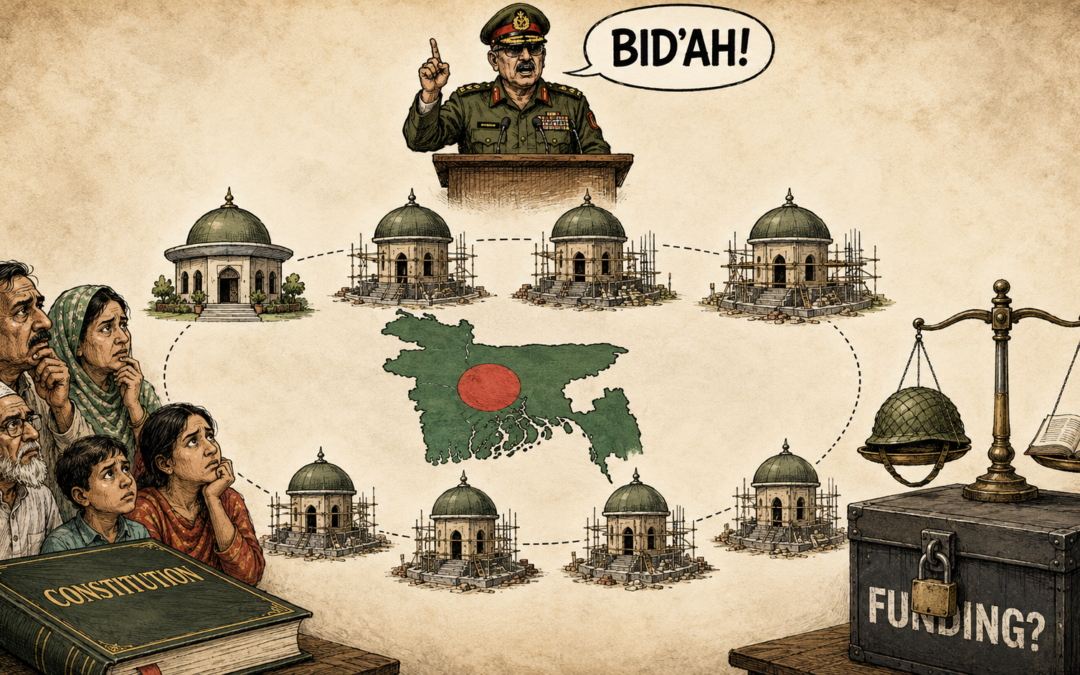
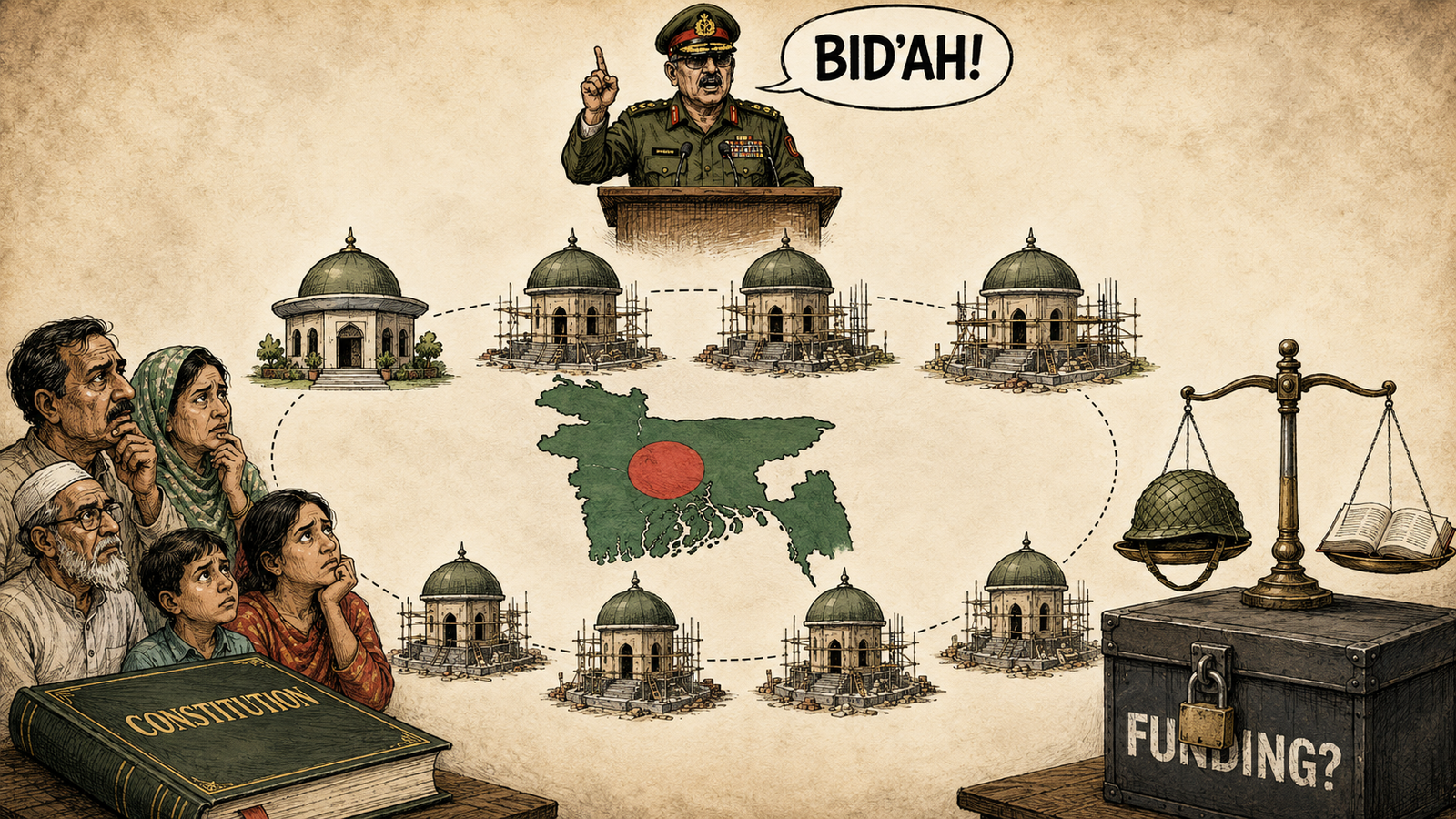
On 3 August 2026, Bangladesh Army Chief General Waker-Uz-Zaman inaugurated the Army International Islamic Institute at Jolshiri Abashon in Dhaka. At the same ceremony, he virtually unveiled foundation stones for seven further institutes in Barishal, Savar, Bogura, Sylhet, Chattogram, Cumilla and Jashore.
Therefore, one institute has opened and seven more are being developed—an eight-campus network created under the authority and supervision of the Bangladesh army. The official explanation is that these institutions will combine Cambridge curriculum-based English-medium education with Islamic teaching and moral values. (ISPR announcement)
On the surface, an education project combining academic excellence with moral instruction may sound commendable. Religious education is legitimate, and many Bangladeshi parents understandably want their children to receive both modern qualifications and a strong ethical foundation.
The concern is not the teaching of Islam. The concern is the extraordinary speed, scale, institutional ownership, theological language and almost complete absence of public explanation surrounding this development.
This is not merely another school opening. It represents the Bangladesh Army—the country’s most powerful, disciplined and heavily armed state institution—entering the field of explicitly religious education on a nationwide scale.
That raises worrying questions with potentially far-reaching and detrimental consequences for the professionalism of the Army, religious harmony, constitutional pluralism, civil-military relations and the long-term stability of Bangladesh.
A remarkably compressed timetable
The foundation stone of the Jolshiri institute was reportedly laid on 20 January 2026. It was inaugurated on 3 August—little more than six months later. At the inauguration, seven additional locations were announced simultaneously.
Such a rapid nationwide expansion could not have been conceived casually. It must have required planning, land allocation, architectural preparation, financing, curriculum development, teacher recruitment, administrative structures and approval from several levels of authority.
Yet the public has not been shown any policy paper, feasibility study, approved budget, governing instrument or parliamentary discussion explaining why eight explicitly Islamic institutions should be established under Army authority.
It would be inaccurate to suggest that every part of the project was literally secret: the January foundation ceremony was public. What remains opaque, however, is the decision-making process behind it. The public has been presented with the outcome—not the reasoning, financing, consultation or chain of approval that produced it.
That is the deeply disturbing aspect. When a national institution makes a major ideological and educational intervention, citizens should not first learn about the full scale of it from a ceremonial inauguration.
Why the word “bid‘ah” matters
The most sensitive element was the Army Chief’s reported use of the word “bid‘ah”—religious innovation—when discussing the supposed consequences of inadequate religious and moral education. Circulating recordings and reports attribute to him the observation that a lack of proper religious and moral education has allowed “bid‘ah and confusion” to spread in society.
The Army Chief’s broader argument was that separating modern education from Islamic education limits the contributions that religiously educated students can make to society. That portion of his speech was reported by The Daily Star. However, the ISPR’s written statement did not include the controversial “bid‘ah” wording. A complete, authoritative transcript should therefore be published.
“Bid‘ah” is not a neutral educational expression. It is a theological judgement. Across the Muslim world, different schools of jurisprudence and religious traditions disagree profoundly over what constitutes unacceptable innovation.
Bangladesh’s Islamic heritage has never been monolithic. It has been shaped by Hanafi jurisprudence, Sufi traditions, shrines, pirs, rural customs, reformist movements, Deobandi institutions, Ahl-e-Hadith teachings and numerous local religious practices. One group may describe a practice as legitimate devotion while another condemns the same practice as bid‘ah.
The moment the head of the Army publicly invokes such a contested term, several serious questions arise:
Who will decide what qualifies as bid‘ah? Which school of theology will guide these institutes? Will Bengali Sufi traditions be respected—or quietly presented as deviations? Will teachers be recruited from one particular ideological background? Could the Army eventually be drawn into theological disputes that have nothing to do with national defence?
These are not abstract questions. In a religiously diverse society, the vocabulary of “correct belief” and “deviation” can become a powerful instrument for excluding, intimidating or delegitimising others.
The Army Chief commands soldiers from different regions, communities and religious backgrounds. His public language must therefore unite the nation—not suggest that the armed forces have adopted one interpretation of Islam as the approved national standard.
Is this a foreign-originated ideological agenda?
The strong denunciation of bid‘ah is often associated today with puritanical Salafi-Wahhabi discourse, particularly currents historically promoted from the Arabian Peninsula. That resemblance understandably leads some observers to ask whether a foreign government, foundation, religious network or donor is influencing or financing this expansion.
That question is legitimate. Declaring a particular foreign country to be the sponsor, however, would go beyond the evidence currently available.
The concept of bid‘ah is centuries older than any modern Middle Eastern state. It is used—though interpreted differently—by scholars and movements throughout the Muslim world. The use of the word alone cannot prove Saudi, Qatari, Pakistani or any other foreign sponsorship.
Ideological resemblance is a reason to investigate; it is not, by itself, proof of financial or operational control.
The real problem is that no sufficiently detailed financial and governance information appears to have been placed before the public. Eight institutions will require substantial land, buildings, staffing, equipment and continuing expenditure. If the project is entirely financed by the Bangladesh Army or another domestic body, that should be stated clearly. If foreign money, curriculum advisers, charities or religious organisations are involved, every relationship should be disclosed.
Secrecy creates the very speculation that transparency could prevent.
The Army must belong equally to every citizen
Bangladesh’s constitutional settlement contains both a recognition of Islam as the state religion and commitments to secularism, freedom of religion and equal status for other faiths. Article 2A requires equal status and equal rights in the practice of Hinduism, Buddhism, Christianity and other religions, while Article 12 addresses secularism and the elimination of communalism. (Constitution of Bangladesh)
The Bangladesh Army is not the armed wing of a particular theological movement. It is the national Army of Muslims, Hindus, Buddhists, Christians, indigenous communities and citizens of every lawful belief.
Army-managed schools, colleges, medical institutions and universities are not new. Many have made valuable contributions to education. But a nationwide chain carrying an explicitly Islamic identity is qualitatively different. It risks sending the message that the Army is gradually redefining itself through one religious framework.
How will a Hindu, Buddhist or Christian soldier perceive this development? Will equivalent educational opportunities be available to their children? Will non-Muslim pupils be admitted? If admitted, will they be required to participate in religious programmes? What safeguards will ensure that no child or military family feels like an outsider within its own national institution?
National confidence in the Army depends on the belief that its uniform stands above sect, party and religious faction.
The danger of mission drift
The Army’s primary responsibility is defending the sovereignty, territorial integrity and security of Bangladesh. It also supports the civil administration during emergencies, disasters and national crises.
Education can be an appropriate supporting contribution, particularly where the Army possesses proven administrative capacity. But the construction of a religious education network raises the danger of institutional mission drift.
Once religious ideology becomes connected to military prestige, land, funding, appointments and career opportunities, it may create new patronage networks. Theological loyalty could gradually acquire institutional value. Officers might begin competing to display religious correctness. Particular scholars or religious movements could gain privileged access to the military establishment.
None of these outcomes has been proven to be occurring. They are foreseeable risks that responsible policymakers must address before the system becomes entrenched.
A professional Army requires unity of command, technical competence, discipline and loyalty to the Constitution. It should never become divided between supposedly more religious and less religious officers, or between competing interpretations of Islam.
History repeatedly shows that once ideological tests enter military institutions, professional judgement can become subordinate to factional identity. That is precisely how national armies become politicised, divided and vulnerable to internal instability.
Why eight—and why now?
If the Jolshiri institute is an educational experiment, why was it not allowed to operate for several years before seven further campuses were initiated?
Where is the independent evaluation demonstrating public demand, educational effectiveness and financial sustainability? Why was a nationwide network announced before the first institute had established a meaningful academic record?
Bangladesh already has thousands of schools, madrasas and Islamic educational institutions. Many suffer from inadequate teacher training, poor infrastructure, financial insecurity and limited access to science, technology and employment pathways. Would national resources produce greater benefit by improving existing institutions under civilian educational authorities?
The official explanation promotes an attractive combination of Cambridge education and Islamic values. But slogans are not substitutes for policy. The public needs to know what “Islamic values” mean in the classroom, who defines them and how competing traditions will be treated.
The questions that must be answered
The Government, Ministry of Defence and Army Headquarters should publish:
- The comple