Is Mirza Fakhrul Islam Alamgir about to become the next President of Bangladesh?
The honest answer, as of 10 August 2026, is: probably—but not yet officially.
Multiple BNP sources say that Prime Minister and BNP Chairman Tarique Rahman has selected Mirza Fakhrul as the party’s presidential candidate. Fakhrul has reportedly signed the consent form, and a formal announcement is expected before nominations close on 13 August. The presidential election is scheduled for 20 August. (The Daily Star)
The opposition alliance has nominated retired Colonel Oli Ahmad, making this potentially Bangladesh’s first contested presidential election in approximately 35 years. Nevertheless, the BNP and its allies possess an overwhelming parliamentary majority. Unless there is an extraordinary rebellion among government MPs, Mirza Fakhrul is the overwhelming favourite. (The Business Standard)
But the real question is not whether he can collect enough parliamentary votes.
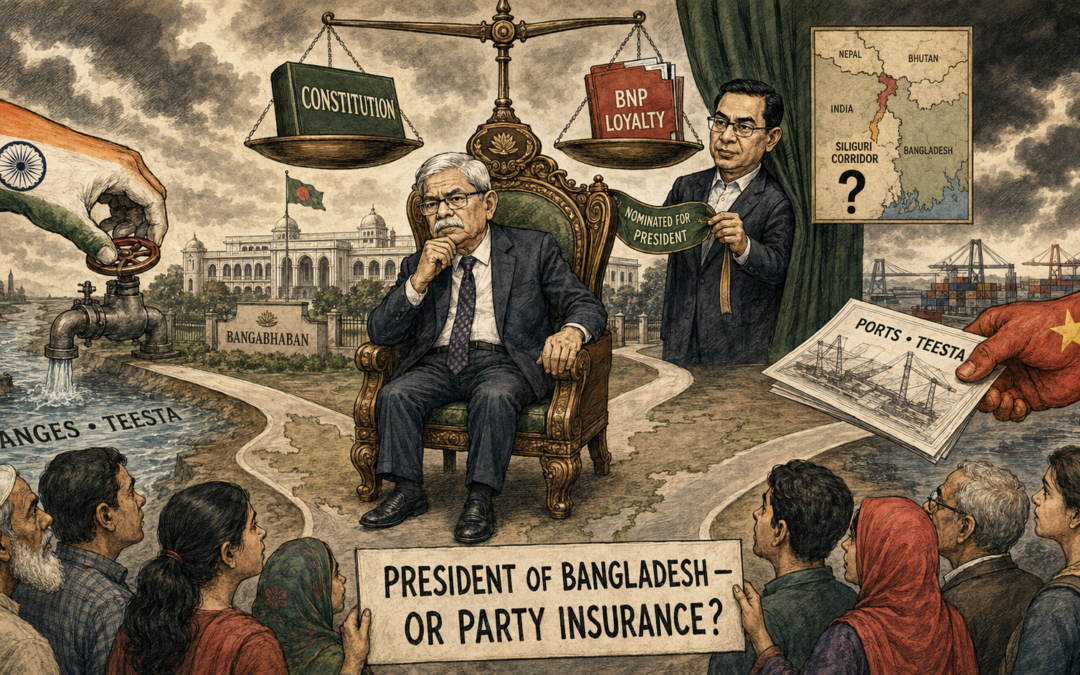
The real question is: What exactly is Tarique Rahman placing inside Bangabhaban—a constitutional guardian, a retiring party loyalist, or a political insurance policy?
A presidency presented as a party reward
The most revealing phrase in the reports is that the presidency would be a “reward” for Mirza Fakhrul’s long contribution to the BNP.
That language should alarm every constitutional democrat.
The presidency is not a retirement present. Bangabhaban is not a party rest house. The office of Head of State should not be distributed as a gold watch for decades of loyal service to a political dynasty.
Mirza Fakhrul has served at the centre of BNP politics for more than fifteen years. He became acting secretary general in 2011 and full secretary general in 2016. He is presently a government minister, MP and one of Prime Minister Tarique Rahman’s most experienced political lieutenants.
Moving directly from the Cabinet and BNP headquarters into Bangabhaban would not automatically transform him into an impartial constitutional authority. It would merely change his office, clothing and address.
The unavoidable question is whether he could say “no” to Tarique Rahman after spending so much of his political career saying “yes” to the party.
A President may come from politics. Most presidents do. But once elected, he must cease to behave as an emissary of the party that nominated him. His loyalty must transfer completely—from the BNP chairman to the Constitution, from party strategy to the Republic, and from one parliamentary majority to the entire nation.
There is currently little evidence that the BNP is seeking such an independent figure. The reports suggest that Tarique Rahman personally finalised Fakhrul’s nomination. That looks less like an independent presidency and more like the prime minister choosing the man who will be expected to sign, approve and legitimise the government’s decisions.
Can the President prolong Tarique Rahman’s rule?
Under the existing Constitution, a President cannot simply issue a decree extending the Prime Minister’s tenure.
Article 48 requires the President to act on the Prime Minister’s advice in almost every matter, apart from the appointments of the Prime Minister and Chief Justice. Article 72 provides that Parliament expires after five years unless dissolved earlier. An emergency proclamation under Article 141A requires the Prime Minister’s prior countersignature. (Constitution of Bangladesh)
Therefore, Fakhrul could not lawfully wake up one morning and proclaim Tarique Rahman ruler indefinitely.
But that does not make the appointment politically harmless.
Authoritarianism rarely announces itself by tearing up the Constitution in the public square. Modern constitutional capture is more sophisticated. It proceeds through amendments, obedient appointments, politically managed commissions, selective enforcement, emergency narratives and the gradual removal of independent restraints.
The danger is not that President Fakhrul could single-handedly prolong Tarique Rahman’s government. The danger is that a compliant President, a two-thirds parliamentary majority, a prime minister who also controls the ruling party, and a government-dominated constitutional-reform process could work together to weaken every institution capable of resisting executive overreach.
The Constitution may remain beautifully printed while its protections are quietly emptied.
This is not an ordinary ceremonial presidency
Bangladesh is presently reconsidering its entire constitutional structure.
A parliamentary committee formed in July is reviewing the whole Constitution, using the July National Charter and the BNP’s election manifesto as central reference points. The opposition has rejected the committee because the BNP refused to establish the separately sworn Constitution Reform Council contemplated by the referendum process. (The Daily Star)
At the same time, the July Charter proposes strengthening the presidency. The President could acquire greater authority over appointments to the Election Commission, Anti-Corruption Commission, Public Service Commission, Human Rights Commission, Information Commission, Press Council, Law Commission and other institutions.
The Charter also proposes that a person holding office in a political party should be ineligible to serve as President. (The Daily Star’s analysis of the proposed powers)
That means Bangladesh may be electing a President under one constitutional arrangement while preparing to give him substantially greater powers under another.
This makes Mirza Fakhrul’s independence exceptionally important.
If presidential powers are expanded while the office is occupied by a freshly transferred BNP secretary general personally selected by the BNP chairman, Bangladesh could create the appearance of checks and balances without their substance.
A President nominally empowered to appoint watchdogs is no democratic safeguard if the President remains psychologically, politically or personally subordinate to the Prime Minister.
BNP’s disturbing history with the presidency
Bangladesh has seen this drama before.
In 2001, BNP founder and former secretary general AQM Badruddoza Chowdhury became President. Within months, the BNP parliamentary party declared that it had lost confidence in him. One of his alleged offences was failing to demonstrate sufficient reverence towards the memory of party founder Ziaur Rahman. Under party pressure, he resigned in June 2002. (The Daily Star)
The message was unmistakable: a BNP-nominated President who displayed insufficient party loyalty could be removed.
Then came President Iajuddin Ahmed and the catastrophic constitutional crisis of 2006–2007. Iajuddin assumed the additional role of Chief Adviser of the caretaker government amid accusations that the outgoing BNP administration had manipulated the succession arrangements. His decisions contributed to a breakdown of confidence, election postponement, emergency rule and military-backed intervention.
These precedents make the present nomination impossible to treat as a routine ceremonial appointment.
Bangladesh must ask whether Fakhrul has been chosen because he would defend the constitutional order—or because Tarique Rahman believes he will never become another Badruddoza Chowdhury.
Is loyalty being rewarded precisely because independence is considered dangerous?
China, India and the struggle surrounding Bangladesh
Bangladesh now stands in an increasingly tense strategic environment.
Relations with India have deteriorated sharply, particularly after New Delhi permitted Sheikh Hasina to address journalists while living in exile. Dhaka described the event as an affront to its sovereignty and continues to demand her extradition. (The Guardian)
Meanwhile, the 1996 Ganges Water Sharing Treaty expires in December 2026, and its renewal has become entangled with Indian domestic politics. The long-promised Teesta agreement remains unresolved.
At the same time, Tarique Rahman’s government is rapidly expanding relations with Beijing. During his June 2026 visit, Bangladesh and China agreed to deepen Belt and Road cooperation, explore direct connectivity, modernise ports, strengthen defence exchanges and establish a possible diplomatic-and-defence “2+2” dialogue. China also agreed to support the feasibility work for the Teesta River Comprehensive Management and Restoration Project. (China–Bangladesh Joint Communiqué)
These are not rumours. They are published policies of Tarique Rahman’s government.
The anxiety surrounding China is therefore not entirely imaginary. Chinese participation in the Teesta project, port infrastructure, defence cooperation and regional connectivity will inevitably attract Indian scrutiny.
But foreign policy remains principally the responsibility of the Prime Minister, Cabinet and Foreign Ministry—not the President. If Bangladesh is moving closer to China, that movement is already being led publicly by Tarique Rahman’s elected government. It does not require a hidden presidential conspiracy.
The more relevant danger is that a loyal President could help protect the government institutionally while these strategic changes are implemented without sufficient parliamentary, financial or security scrutiny.
The Siliguri Corridor: strategic reality and exaggerated suspicion
The Siliguri Corridor is unquestionably one of South Asia’s most sensitive strategic locations. At its narrowest, this Indian strip is approximately 20–22 kilometres wide and connects mainland India with its northeastern states. Bangladesh lies to its south, Nepal to the west and Bhutan to the north, with China further north beyond Bhutan and the disputed Himalayan frontier.
One factual correction is essential: Bangladesh and China do not share a land border.
Panchagarh, Tetulia, Banglabandha and Thakurgaon are close to the approaches to the Siliguri Corridor, but geographical proximity does not make every politician born there an instrument of Chinese policy.
Security agencies should naturally monitor foreign infrastructure, unusual land acquisition, communications systems and external political financing in strategically sensitive districts. That is prudent statecraft.
But drawing a straight line from a politician’s birthplace to Beijing is not evidence. Geography may justify scrutiny; it cannot establish guilt.
What does the Mirza family history actually prove?
Mirza Fakhrul’s uncle, former Speaker Mirza Ghulam Hafiz, came from Panchagarh. Banglapedia records that he became president of the Pakistan-China Friendship Association in 1956. That is a documented historical connection with early China-oriented diplomacy. (Banglapedia)
But the same biography records that Hafiz participated in the Language Movement, was imprisoned in 1952 and 1954, supported civil liberties and provided legal assistance to defendants in the Agartala Conspiracy Case.
His historical record was therefore more complicated than the description “Chinese-sponsored political operative” suggests. I have not found reliable documentary evidence proving that Beijing financed or controlled him.
Claims have also circulated that Mirza Fakhrul’s father, Mirza Ruhul Amin, was a member of a Peace Committee or opposed Bangladesh’s Liberation War. Fakhrul denies those allegations and says his father spent most of 1971 with the family in a refugee camp in India. Contemporary reporting presents the matter as a disputed political allegation—not an established conviction. (Prothom Alo)
Nor have I found reliable evidence that both his father and Mirza Ghulam Hafiz were convicted and imprisoned after independence for their roles in 1971. Available biographies refer to Ghulam Hafiz’s earlier imprisonments during the Language Movement—not imprisonment for collaboration in 1971.
Another uncle, Wing Commander S.R. Mirza, reportedly served the Mujibnagar Government and helped oversee youth camps connected with freedom-fighter recruitment.
This does not settle every historical controversy. It demonstrates why family history must be investigated through archives rather than party slogans.
Mirza Fakhrul should be judged by his own actions, affiliations, decisions and commitments. Constitutional fitness cannot be determined through inherited guilt. Otherwise, Bangladesh will replace the rule of law with political genealogy.
Do Speakers always come from the Siliguri region?
No.
The official historical list includes Speakers associated with Noakhali, Barishal, Khulna, Sylhet, Kishoreganj, Bhola and other parts of Bangladesh, as well as several from the northern region. The present Speaker and acting President, Hafiz Uddin Ahmad, represents Bhola-3—not a constituency near the Siliguri Corridor. (Bangladesh Parliament’s list)
There is a noticeable northern connection in the cases of Mirza Ghulam Hafiz and Muhammad Jamiruddin Sircar, both associated with Panchagarh. Shirin Sharmin Chaudhury represented Rangpur-6, although she was born in Noakhali.
That is not enough to establish a Chinese pattern.
Speakers are normally chosen through ruling-party calculations involving loyalty, seniority, constituency security, legal experience and internal factional balance. No credible evidence currently demonstrates that China has influenced these selections.
A strategic hypothesis deserves investigation. A repeated coincidence may justify questions. But a question does not become a conclusion merely because it is repeated loudly.
The tests Mirza Fakhrul must pass
If elected, Fakhrul should immediately:
- Resign from every BNP office and publicly renounce taking instructions from the party chairman.
- Declare that his constitutional loyalty overrides personal loyalty to Tarique Rahman.
- Publish a complete statement of interests, including foreign organisational, financial and institutional relationships.
- Promise not to support any attempt to extend Parliament or government beyond constitutional limits.
- Insist that expanded presidential appointment powers operate through transparent, multiparty search committees.
- Refuse to appoint party loyalists to the Election Commission, Anti-Corruption Commission, judiciary or other watchdog bodies.
- Demand broad political consensus before approving fundamental constitutional restructuring.
- Require parliamentary scrutiny of strategic agreements involving ports, defence cooperation, communications systems and water infrastructure.
- Support a balanced foreign policy in which Bangladesh engages India, China and other powers without becoming anybody’s satellite.
- Release an explicit statement reaffirming the sovereignty, democratic principles and Liberation War foundations of Bangladesh.
These commitments should be made before the presidential vote—not afterwards, when parliamentary accountability will be far weaker.
The Constitution is endangered by obedience, not ancestry
Mirza Fakhrul may be dignified, experienced and outwardly moderate. Those qualities are not irrelevant. But courtesy is not constitutional courage, and longevity in party service is not proof of independence.
Bangladesh does not need a courteous rubber stamp.
It needs a President capable of telling the Prime Minister that the state is larger than the BNP, the Constitution is stronger than a party manifesto, and Bangladesh’s foreign policy cannot be reduced to an “India out, China in” pendulum.
The gravest concern is not that Mirza Fakhrul’s relatives once lived near the Siliguri Corridor or participated in Pakistan-era organisations. The real concern is visible in the present: an overwhelmingly powerful Prime Minister personally selecting his long-serving party secretary for the presidency while the ruling party reviews the entire Constitution.
That combination should set every democratic alarm ringing.
Mirza Fakhrul is likely to become the next President. Whether Bangladesh’s Constitution will be safe in his hands depends on whether he enters Bangabhaban as an independent guardian of the Republic—or as Tarique Rahman’s most elaborately decorated political insurance policy.
The nation must demand the answer before the votes are counted.