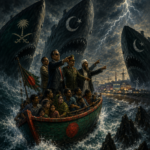
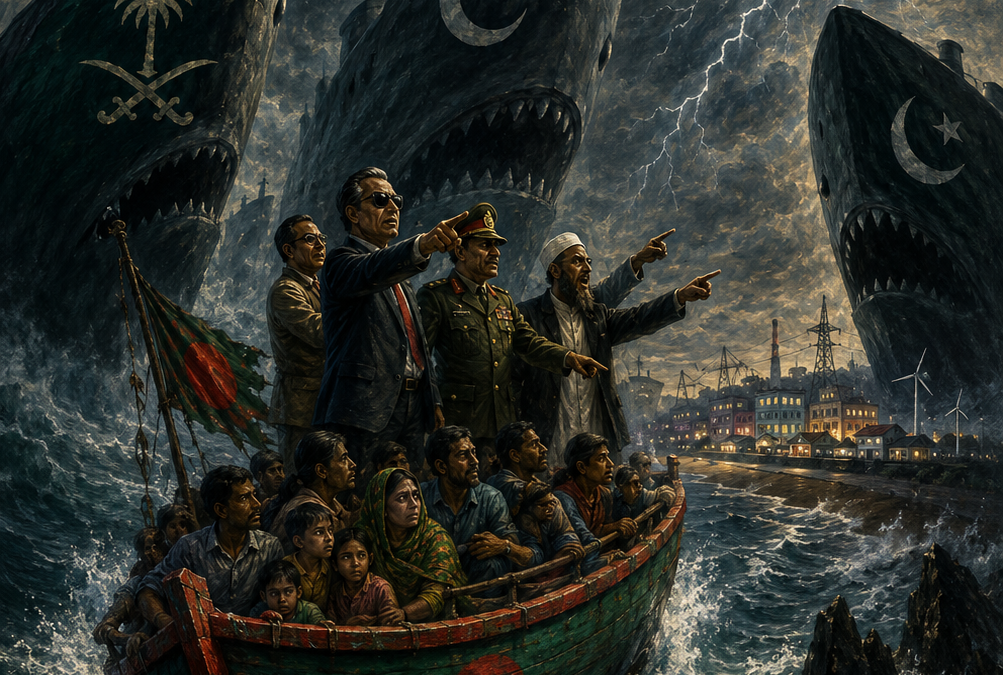
Bangladesh appears to be standing at the edge of the Bay of Bengal, preparing to board a magnificently decorated ship. Its sails bear the symbols of Saudi Arabia, Türkiye and Pakistan. On the deck, ambitious politicians, newly radicalised officers, retired generals and religious demagogues wave enthusiastically, promising dignity, Islamic unity and strategic power.
There is only one difficulty: the ship is heading directly towards the rocks.
The proposed destination is an imaginary “Islamic NATO”—a grandiose alliance that exists more vividly in the fantasies of political opportunists than in credible strategic planning. Its advocates speak as though religious slogans can replace geography, economics, diplomacy and national interest. They imagine Bangladesh joining a heroic Muslim military bloc and confronting India from a position of strength.
It is not strategy. It is adolescent adventurism dressed in a general’s uniform.
Saudi Arabia approaches as the wealthy shark, offering religious prestige, investment and diplomatic attention—but always on terms shaped by Saudi priorities. Türkiye arrives with polished speeches, defence products and dreams of reviving Ottoman-era influence. Then comes Pakistan: the former occupying power whose military establishment presided over the slaughter, persecution and displacement of Bengalis in 1971.
Pakistan now presents itself as Bangladesh’s long-lost brother.
One must admire the audacity.
The state that attempted to silence Bengali identity through military violence now wishes to rediscover Islamic fraternity. Apparently, history is expected to disappear beneath a carpet of ceremonial visits, defence discussions and carefully staged handshakes. Bangladesh is being invited to forget the blood of 1971 and accept strategic guidance from the very establishment whose catastrophic arrogance helped create Bangladesh in the first place.
Only a nation suffering from manufactured amnesia would consider this progress.
The most alarming element is the apparent rise of sections within Bangladesh’s political and military circles that view Pakistan, Saudi Arabia and Türkiye through a haze of romantic religious solidarity. Some serving and retired officers, right-wing politicians and radical groups appear intoxicated by the idea of belonging to a powerful Muslim axis.
They speak of brotherhood but seldom mention interests. They speak of military cooperation but ignore economic consequences. They speak of confronting India but offer no credible explanation of how Bangladesh would survive the confrontation they seem so eager to provoke.
Hatred of India—and, more dangerously, hostility towards Hindus—is being marketed as patriotism. It is neither patriotic nor intelligent. It is a cheap political narcotic administered to a public frustrated by inequality, corruption and weak governance. Instead of solving Bangladesh’s internal problems, opportunists point across the border and announce that every national failure is somebody else’s conspiracy.
India is not a charitable organisation, and Bangladesh should never surrender its sovereignty or accept unfair pressure from New Delhi. Every disagreement must be negotiated firmly. But opposing Indian policies is entirely different from constructing an anti-India state doctrine based on religious hostility.
India is Bangladesh’s unavoidable neighbour. The two countries share a border of more than 4,000 kilometres, extensive commercial links, rivers, energy arrangements, transport routes and deeply interconnected security concerns. Saudi Arabia, Türkiye and Pakistan may offer applause from a comfortable distance. None of them can alter Bangladesh’s geography.
Dhaka can change its friends. It cannot relocate the country.
If Bangladesh allows anti-India militancy to become a pillar of state policy, the economic consequences could be severe. Bilateral trade could contract. Cross-border transport and transit arrangements could be restricted. Energy cooperation could be reconsidered. Supplies of electricity, petroleum products, food, cotton, machinery, chemicals and industrial inputs could face disruption or become substantially more expensive.
Who would pay the price? Not the generals discussing geopolitics inside air-conditioned conference rooms. Not the politicians travelling under police escort. Not the preachers promising victory from television studios.
The bill would be presented to ordinary Bangladeshis.
Food prices could rise beyond the reach of lower- and middle-income families. Manufacturing costs could increase. The ready-made garments and textile industries—already operating under intense global competition—could face delays, higher input prices and damaged supply chains. Medical travel to India, used by many Bangladeshis because of proximity and relative affordability, could become harder and more expensive.
Even air connectivity cannot be treated casually. If India concluded that Bangladesh had become a platform for hostile military or terrorist activity, it could consider restrictions involving overflight access, transit arrangements or security cooperation. Whether such measures would occur is uncertain, but any responsible government must consider the possibility before playing games with national security.
The darkest danger is that an ideological military alignment could open Bangladesh to transnational extremist networks. Under the convenient label of religious solidarity, foreign preachers, financiers, recruiters and militant intermediaries could seek access to Bangladeshi institutions and territory. Bangladesh could once again be used by organisations attempting to infiltrate India or conduct destabilising operations across the border.
One serious attack traced back to Bangladeshi soil could transform a foolish diplomatic adventure into a national catastrophe.
India would respond according to its security interests. International investors would reassess Bangladesh’s stability. Western governments could impose scrutiny or sanctions. Banks would tighten compliance controls. Garment buyers would worry about reputational and supply-chain risks. Tourism and foreign investment would suffer.
Meanwhile, the architects of the disaster would probably appear on television and blame India.
This is the familiar cowardice of failed nationalism: provoke a crisis, deny responsibility and then use the resulting suffering as evidence of foreign persecution.
Bangladesh was not created in 1971 to become Pakistan’s resentful younger partner. It was created because Bengalis rejected domination, military arrogance and the use of religion to suppress language, culture and democratic rights. To crawl back into Pakistan’s strategic shadow would not represent Islamic solidarity. It would represent historical humiliation.
Nor should Bangladesh exchange one dependency for another. Saudi Arabia and Türkiye will pursue their interests, just as India, China, Pakistan and every other state pursue theirs. Bangladesh must do the same. Friendship should be broad, conditional and based upon measurable national benefit—not emotional sermons about religious brotherhood.
A mature Bangladesh would maintain working relations with all these countries while refusing to become anybody’s pawn. It would cooperate with India without becoming submissive, engage China without becoming indebted, work with Gulf states without importing ideological extremism, and deal with Pakistan without surrendering the truth of 1971.
But the reckless adventurers now dreaming of an anti-India Islamic warship appear determined to drag the country aboard.
They should look carefully at the vessel. Saudi Arabia may provide the fuel. Türkiye may sell the weapons. Pakistan may draw the map. Bangladeshi extremists may beat the drums.
But when the ship strikes the rocks, it will be the people of Bangladesh who drown.