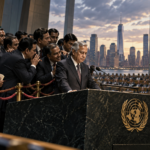
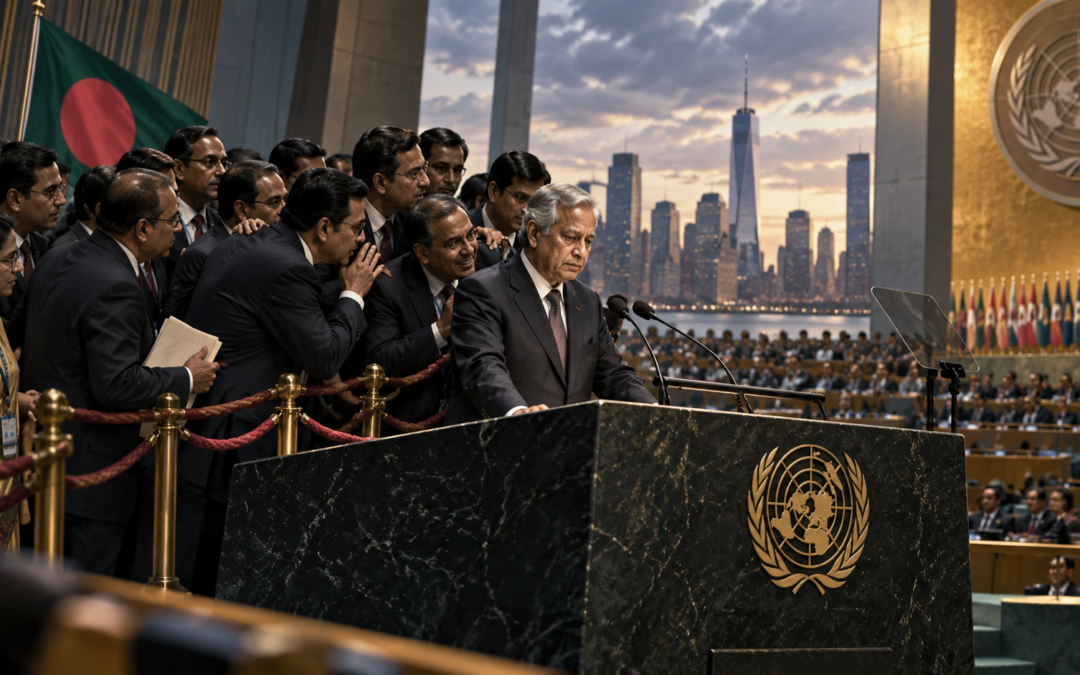
There are moments when a political leader travels abroad as an individual, and there are moments when he carries an entire country on his shoulders. A Prime Minister attending the United Nations General Assembly belongs firmly to the second category.
t, but as a presentation of Bangladesh itself before the world.
And that is precisely why the optics of the New York visit deserve serious examination.
The formal programme was substantial. Rahman led a 35-member delegation, addressed the 81st United Nations General Assembly in Bengali, attended a reception hosted by the President of the United States, participated in meetings concerning the Rohingya crisis and climate change, and held a series of international engagements.
Those are facts and should not be diminished.
Yet international leadership is not measured by diary appointments alone.
There is also presence.
There is bearing.
There is language.
There is the ability to enter a room occupied by presidents, prime ministers, diplomats, bankers and international institutions and convey—without theatricality—that the person standing before them represents a nation of nearly 180 million people.
This is where Bangladesh should engage in some uncomfortable introspection.
The Prime Minister Is Not Merely a Party Leader Abroad
A recurring weakness in South Asian politics is the inability of political movements to separate the party leader from the head of government.
New York witnessed considerable mobilisation by BNP organisations and affiliated groups. Before Rahman arrived, reports described extensive preparations by party activists in Jackson Heights, involving banners, processions and numerous organisational meetings.
Support from expatriates is perfectly legitimate.
But once a politician becomes Prime Minister, international visits require a different visual vocabulary.
The surroundings of a national leader matter.
The delegation matters.
Who appears constantly beside him matters.
The choreography matters.
A Prime Minister abroad should appear surrounded primarily by the machinery of the state—diplomats, ministers, economic advisers, strategic specialists and officials—rather than giving the impression of remaining at the centre of a travelling political court.
Bangladesh has spent too many decades confusing access to power with proximity to the powerful.
A modern republic should move beyond that culture.
From Dhaka Politics to Global Statesmanship
There is another distinction worth making.
A politician may dominate a domestic political meeting through familiarity, slogans, humour, party loyalty and personal relationships.
The international arena works differently.
Global diplomacy rewards concision, preparation, intellectual command, confidence and an instinctive understanding of protocol.
A national leader must project weight.
Not physical grandeur.
Not arrogance.
Not theatrical gestures.
Political weight comes from command of the brief, clarity of language, economy of expression and the ability to make others listen.
Bangladesh desperately needs that kind of statesmanship because the country has an extraordinary story to tell.
It is one of the world’s largest garment exporters.
It sits strategically between South and Southeast Asia.
It faces the Bay of Bengal.
It is central to Indo-Pacific calculations.
It carries the burden of more than a million Rohingya refugees.
It has enormous demographic and economic potential.
Its climate vulnerability gives it an important voice in international environmental diplomacy.
The speech with mispronounced mother tongue words was seen as painful by many
A Bangladeshi Prime Minister therefore arrives at the United Nations with considerable material from which to construct diplomatic authority.
The office already possesses weight.
The challenge is to carry that weight convincingly.
Bengali or English Is Not the Real Question
Much may be said about language.
Rahman chose Bengali for his UN General Assembly address, as had been announced beforehand.
There is absolutely nothing inferior about addressing the United Nations in Bengali.
Quite the opposite.
Bangla is the language for which people gave their lives in 1952. It is one of the great literary languages of Asia—the language of Rabindranath Tagore, Kazi Nazrul Islam, Jibanananda Das and generations of thinkers, poets and political leaders.
The question, therefore, should never be:
Why Bengali?
The question should be:
How effectively does a leader command whichever language he chooses?
A statesman speaking Bengali magnificently can command an international hall through interpreters.
A statesman speaking English magnificently can do the same directly.
The language itself does not manufacture authority.
Command of language does.
Rhythm matters. Precision matters. Pauses matter. Vocabulary matters. The ability to lift a sentence beyond bureaucratic prose matters.
International political communication is not simply the act of reading prepared words into a microphone.
It is the art of making a nation audible.
The Mystery Surrounding the Wider US Programme
Another issue generated considerable speculation before and during the visit.
Commentators questioned why a broader American programme—including diaspora activities reportedly anticipated earlier—did not feature prominently in the final itinerary.
Some publications linked this to longstanding allegations concerning US immigration restrictions.
That conclusion cannot presently be stated as fact.
There is no publicly available US government confirmation establishing that Rahman was confined to New York, forbidden from travelling elsewhere in the United States, or prevented by American authorities from holding a community reception. Analysis of the issue has correctly noted that the available evidence does not establish what visa classification he received or whether any geographical restriction existed.
A separate report said that a planned New York reception had been cancelled amid organisational and financial controversy within the local party structure rather than establishing an American prohibition.
These distinctions matter.
Criticism loses force when conjecture is dressed as fact.
There is enough to debate about political presentation without manufacturing evidence that does not yet exist.
Bangladesh Deserves Presidential-Level Preparation
The larger question goes beyond Tarique Rahman.
Bangladesh has for decades allowed the culture of domestic party politics to accompany its leaders overseas.
Supporters gather.
Slogans follow.
Party personalities surround the leader.
Diaspora factions compete for photographs, invitations and proximity.
Sometimes rival political groups confront one another abroad—as happened again around this visit in Jackson Heights, where BNP and Awami League supporters clashed and New York police intervened.
What does any of this contribute to Bangladesh’s international standing?
Almost nothing.
When the Prime Minister leaves Hazrat Shahjalal International Airport, he should temporarily cease to belong to BNP supporters alone.
He becomes the Prime Minister of the farmer in Rangpur, the garment worker in Gazipur, the fisherman in Bhola, the entrepreneur in Dhaka, the student in Sylhet, the Hindu family in Khulna, the Buddhist in the Chittagong Hill Tracts, the expatriate worker in the Gulf and the Bangladeshi scientist working in London or Boston.
That transformation must be visible.
A Country Larger Than Its Political Parties
Bangladesh is now too consequential to present itself internationally through the vocabulary and rituals of provincial party politics.
Its leaders—of whichever party—should arrive on the world stage carrying the confidence of an increasingly important Asian state.
They should look beyond entourages.
Beyond slogans.
Beyond sycophancy.
Beyond the culture of men competing to stand closest to the leader.
The world is brutally pragmatic.
Foreign governments do not care how many people shout a politician’s name in Jackson Heights.
Investors do not measure leadership by the number of garlands received.
Diplomats do not calculate strategic influence through Facebook photographs.
They look for credibility, predictability, intellectual command, economic opportunity and national purpose.
That is the currency of international influence.
The Lesson From New York
Tarique Rahman’s New York programme contained genuine diplomatic engagements, and any assessment should acknowledge them.
But Bangladesh should demand something larger from every future appearance by its Prime Minister—whether that Prime Minister is Tarique Rahman or anybody else.
Preparation.
Presence.
Command.
Dignity.
A statesman’s distance from the culture of political courtiers.
And, above everything else, an understanding that when a Bangladeshi Prime Minister walks into the United Nations, the world is not merely looking at one politician.
For those few minutes, it is looking at Bangladesh.
A country born through extraordinary sacrifice deserves to be represented with corresponding confidence and gravitas.
Bangladesh does not need its leaders to appear larger than the country.
It needs leaders who understand that the country is already larger than them.