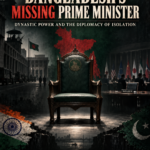
Bangladesh’s Missing Prime Minister: Tarique Rahman, Dynastic Power and the Diplomacy of Isolation
Bangladesh has acquired another hereditary ruler—this time presented to the nation in the language of democratic restoration.
Prime Minister Tarique Rahman is the political heir of President Ziaur Rahman, the martial-law ruler who transformed military authority into a political dynasty. Zia institutionalised a model that owed more to Pakistan’s Field Marshal Ayub Khan than to the pluralistic aspirations of Bangladesh’s Liberation War.
Ayub Khan called his controlled political system “Basic Democracy.” Bangladesh has repeatedly experimented with its own version: democracy managed through cantonments, intelligence offices, administrative corridors and discreet safe houses. Elections are held, ballots are displayed and results are announced—but the boundaries of acceptable politics are frequently determined long before the electorate reaches the polling station.
Tarique Rahman is now the third beneficiary of this carefully cultivated inheritance: first his father, then his mother, and now the son. The family tree has become a political succession plan.
An Election Beneath the Long Shadow of the State
The February 2026 parliamentary election gave the Bangladesh Nationalist Party an overwhelming majority, while a constitutional referendum was held simultaneously. International observers described the election as broadly peaceful and credible. Yet the political field was plainly incomplete: the Awami League—the party historically associated with the birth of Bangladesh—was prohibited from contesting.
Bangladesh’s crisis of electoral credibility, however, did not begin in 2026. Since the military coup d’état of 15 August 1975, successive elections have repeatedly faced grave allegations of manipulation by the Army, police, civil administration and other coercive arms of the state—including, at different times, the Bangladesh Rifles and its successor, the Border Guard Bangladesh, as well as the Rapid Action Battalion.
From the preparation of voter lists and control of polling centres to the transportation of ballot boxes, counting of votes and declaration of results, the electoral process has too often operated beneath the shadow of uniforms, intelligence agencies and partisan administrators.
The methods alleged across the decades form a grim catalogue: fabricated tallies, tampered ballot boxes, ballot stuffing, intimidation of voters, expulsion of opposition polling agents, occupation of voting centres and the alteration of results somewhere between the polling station and the returning officer’s desk.
There have also been persistent accusations that soldiers and other security personnel—sometimes in uniform and sometimes dressed in civilian clothing—were deployed to stamp ballot papers methodically and manufacture the appearance of a popular mandate.
Not every election since 1975 was manipulated in precisely the same manner or to the same degree. Nevertheless, the recurring involvement of military, paramilitary, police, intelligence and administrative institutions has produced an enduring public suspicion: in Bangladesh, election results have too often appeared to be constructed by the machinery of the state rather than freely determined by the electorate.
Therefore, the question cannot simply be whether the ballots cast in February 2026 were counted correctly. The deeper question is whether the democratic arena had already been narrowed, managed and politically sanitised before voters entered it.
A landslide achieved in the absence of a principal political rival may produce parliamentary power, but it cannot automatically confer unquestionable democratic legitimacy. The election and referendum may have formally enthroned Tarique Rahman, but they cannot erase the uncomfortable impression that Bangladesh has merely exchanged one dynastic establishment for another—or that the machinery of managed democracy has once again found a new civilian beneficiary.
The Unprepared Heir on a Burning Chair
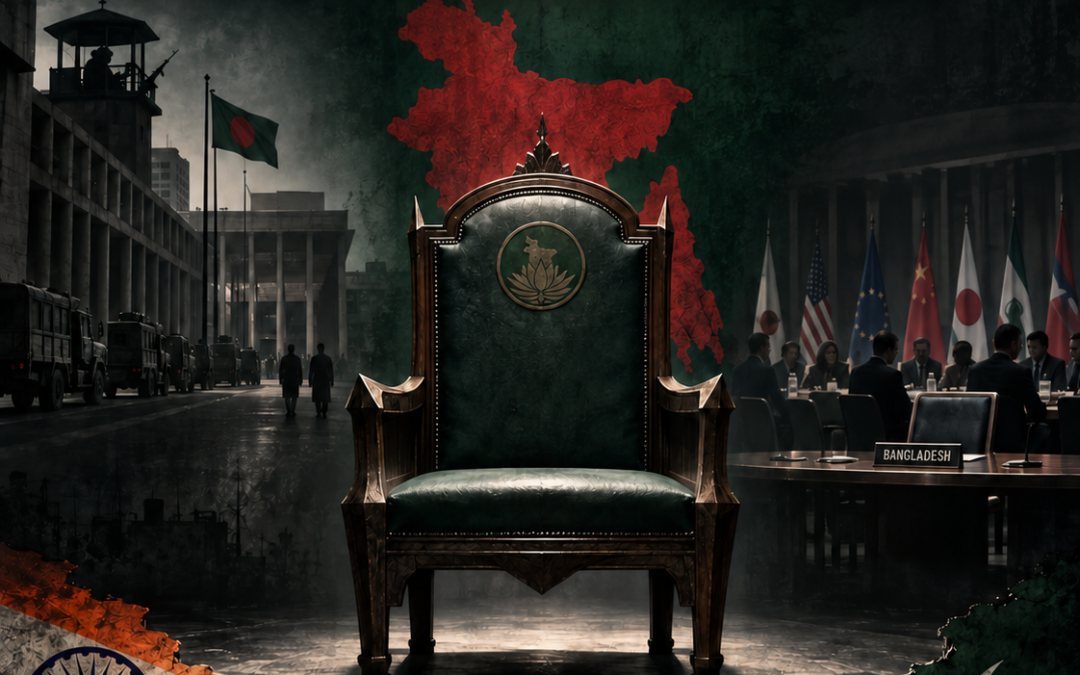
Tarique Rahman now occupies one of the most difficult seats in Asia—a spiky, burning chair studded with economic, diplomatic, constitutional and security dangers.
Yet what executive, administrative, diplomatic or professional experience prepared him for it?
His political authority rests overwhelmingly upon his surname, inherited position and control of the BNP organisation. Outside the machinery of dynastic politics, his record offers little reassurance that he has managed a national economy, administered a major institution or conducted complex international negotiations.
Bangladesh is not a family estate. It is a nation of approximately 170 million people, positioned between India, China and the Bay of Bengal. Its economic survival depends upon international trade, imported energy, overseas employment, foreign investment, garment exports and delicate regional cooperation.
Such a country cannot be governed through the habits of opposition politics, party drawing rooms, intelligence briefings or memories of parental power.
The tragedy is that the new government inherited an extraordinary opportunity. After years of authoritarianism, unrest, violence and political bloodshed, it could have demonstrated maturity, reconciliation and strategic confidence.
Instead, Bangladesh appears to be drifting towards diplomatic isolation.
Why Was the Prime Minister Missing?
The BRICS summit in New Delhi brought together leaders representing the commanding heights of the Global South. Russia, China and India—three continental giants—were present alongside other major emerging powers.
Bangladesh’s prime minister was absent.
Why?
Was Tarique Rahman reluctant to meet international dignitaries? Was he uncomfortable entering an unscripted diplomatic arena? Did he fear difficult questions? Was he concerned about protocol or the political consequences of being photographed beside India’s leadership? Or did advisers within his government persuade him that remaining at home would somehow represent strength?
Dhaka claimed that Tarique Rahman had not received a direct invitation as prime minister but had instead been invited in his capacity as chair of BIMSTEC. India subsequently maintained that he had been invited both to attend the BRICS gathering and to undertake a bilateral visit.
Both accounts cannot comfortably occupy the same diplomatic space.
If an invitation existed, refusing or mishandling it was a serious strategic blunder. If the invitation was considered insufficiently flattering, then Bangladesh’s national interest was sacrificed upon the altar of personal protocol and political vanity.
A confident leader would have attended and used the occasion to engage Narendra Modi, Vladimir Putin, Xi Jinping and other leaders. He would have presented Bangladesh as an assertive, independent and economically ambitious state.
That would not have represented submission to India. It would have demonstrated Bangladesh’s relevance.
Diplomacy is not conducted by sulking at home. Nor is national dignity protected by leaving Bangladesh’s chair empty while the leaders of the Global South determine the future of trade, finance, energy, security and international cooperation.
The honourable prime minister appears to have gone absent without leave from one of the most important diplomatic opportunities available to his young government.
India: The Neighbour Bangladesh Cannot Wish Away
India is Bangladesh’s immediate neighbour. Geography is not an editorial opinion, and it cannot be overturned by political slogans.
The two countries share more than 4,000 kilometres of border, 54 transboundary rivers, extensive trade, energy connections, transport corridors and intertwined security concerns. Millions of lives on both sides are affected by decisions made in Dhaka and New Delhi.
The relationship unquestionably contains legitimate grievances. Bangladesh has every right to raise border killings, unresolved water sharing, trade imbalances, migration, political interference and India’s perceived preference for particular Bangladeshi governments.
Bangladesh must negotiate firmly, confidently and independently. But firmness is not the same as hostility, and sovereignty is not strengthened through diplomatic self-isolation.
Looking through the celluloid of 1971 reveals an even more striking contradiction. Tarique Rahman’s father, Major Ziaur Rahman, participated in a liberation struggle in which Bangladeshi freedom fighters and the Indian Armed Forces ultimately fought hand in glove.
India trained and supported Mukti Bahini fighters, sheltered approximately ten million refugees and entered the war that culminated in the surrender of the Pakistan Eastern Command on 16 December 1971.
Military cooperation with India was acceptable when Bangladesh’s survival required it. Why, then, must ordinary diplomatic engagement with India now be portrayed almost as an ideological betrayal?
History must never make Bangladesh subordinate to India. India’s contribution in 1971 does not provide New Delhi with a permanent licence to interfere in Bangladesh’s domestic politics. But neither should selective amnesia transform an indispensable neighbour into an eternal enemy.
A responsible Bangladeshi government must be capable of remembering India’s contribution, challenging India’s misconduct and maintaining a functional relationship—all at the same time.
Courting Pakistan While Forgetting 1971
Even more bizarre is the government’s apparent enthusiasm for warmer relations with Pakistan while relations with India are allowed to freeze.
States are not required to maintain eternal hostility. Bangladesh and Pakistan may trade, communicate and develop normal diplomatic relations. Reconciliation can be desirable, but genuine reconciliation requires historical honesty.
Pakistan has still not delivered the full, unequivocal and state-level apology that Bangladesh deserves for the genocide, mass rape, destruction and displacement committed in 1971. The victims cannot simply be airbrushed from history because a new government finds Islamabad strategically, militarily or ideologically convenient.
Normalisation without accountability risks becoming national amnesia.
Pakistan was not merely an opponent in an ordinary border war. Its military attempted to destroy the democratic verdict delivered by the Bengali electorate in 1970. Its forces murdered civilians, intellectuals, students, police officers, soldiers and members of the East Pakistan Rifles. Women were subjected to systematic sexual violence. Villages were burned, towns were devastated and millions fled for their lives.
A Bangladeshi government that grows cold towards the country that assisted its liberation while becoming conspicuously warm towards the state responsible for those atrocities must explain its moral and strategic arithmetic.
Why is India increasingly treated as an adversary while Pakistan is rehabilitated as a potential strategic companion? Is this foreign policy, or is it the return of an ideological inheritance that Bangladesh should have buried in 1971?
The Makkah Pact: An Alliance in Search of a Threat
The discussion about Bangladesh potentially joining the Makkah Joint Defence Agreement—formed by Saudi Arabia, Türkiye and Pakistan—raises even more serious questions.
Against whom would Bangladesh seek collective defence?
What precise obligations would membership create? Could Bangladesh be expected to provide troops, bases, logistical assistance or intelligence? Could Bangladeshi forces be drawn into conflicts in the Middle East? Would Dhaka inherit the adversaries of countries whose strategic interests bear little resemblance to its own?
Most importantly, could membership place Bangladesh inside Pakistan’s strategic confrontation with India?
The government has no moral right to carry Bangladesh into a military alliance through religious sentiment, closed-door calculation or emotive rhetoric about Muslim solidarity. Any proposal to join such a pact must be debated openly in Parliament, scrutinised by defence and foreign-policy specialists and explained comprehensively to the Bangladeshi people.
Religion is not a substitute for strategy.
Bangladesh’s Armed Forces exist to protect Bangladesh’s territory, sovereignty and population. They must not become expeditionary accessories to another country’s regional ambitions or ideological conflicts.
Saudi Arabia, Türkiye and Pakistan will each pursue their own interests. Bangladesh must do the same. Friendship with Muslim-majority countries is valuable, but friendship does not require strategic surrender.
A nation that escaped one military union in 1971 should exercise exceptional caution before entering another.
A Country Must Be Led, Not Inherited
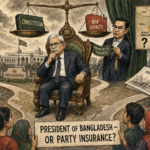
Tarique Rahman must now decide whether he intends to become the prime minister of a republic or merely the custodian of a family franchise.
Bangladesh does not need another ruler surrounded by courtiers, intelligence intermediaries, inherited loyalists and political flatterers. It needs a statesman prepared to meet difficult neighbours, face unsympathetic audiences, answer challenging questions and defend the national interest without hiding behind slogans.
The prime minister cannot remain absent whenever diplomacy becomes uncomfortable. He cannot substitute anti-India rhetoric for a coherent India policy. He cannot seek the warmth of Islamabad while pretending that the ashes of 1971 have grown cold. Nor can he flirt with distant military alliances without explaining the possible cost to Bangladesh’s independence and regional security.
A leader who avoids the international stage does not protect his country from embarrassment. He advertises weakness.
Bangladesh now stands at a dangerous junction. One road leads towards balanced diplomacy, economic cooperation and sovereign engagement with India, China, Russia, the West and the Muslim world. The other leads towards ideological alliances, strategic dependency, regional suspicion and increasing isolation.
Tarique Rahman may have inherited his party, his position and one of the most powerful surnames in Bangladesh.
He has not inherited the automatic right to gamble with Bangladesh’s future.